
If you’ve ever stared at your equity grant letter and wondered exactly how many shares you actually own today, you’re not alone. Knowing how to calculate vested shares matters whenever you’re weighing a job offer, thinking about resigning, or just trying to understand what’s really yours versus what’s still sitting on the table.
The good news is that the math behind vesting isn’t complicated once you know the formula. This guide walks through exactly how vested shares are calculated, using real numbers for RSUs, stock options, and mixed cliff-and-graded schedules, so you can check your own grant with confidence.
In this guide, you’ll learn:
- What vesting actually means and how a vesting schedule controls your ownership timeline
- The exact formula used to calculate vested shares, with cliff and graded examples
- How the math differs for RSUs versus stock options
- How to handle monthly, quarterly, and yearly vesting frequencies
- What happens to your shares if you leave the company early
- How vested shares get taxed, and which IRS forms are involved
- Common mistakes people make when calculating their own vesting
Table of Contents
- What Does “Vested Shares” Mean?
- The Basic Formula for Calculating Vested Shares
- Vesting Schedule Types and How Each One Is Calculated
- Step-by-Step: How to Calculate Your Vested Shares
- Worked Example: RSUs With a Cliff and Monthly Vesting
- Worked Example: Stock Options With Quarterly Vesting
- RSUs vs. Stock Options vs. ESPP: Vesting Comparison
- How Vested Shares Are Taxed
- What Happens to Unvested Shares If You Leave
- Common Mistakes to Avoid
- Glossary of Vesting Terms
- Key Takeaways
- FAQs
What Does “Vested Shares” Mean?
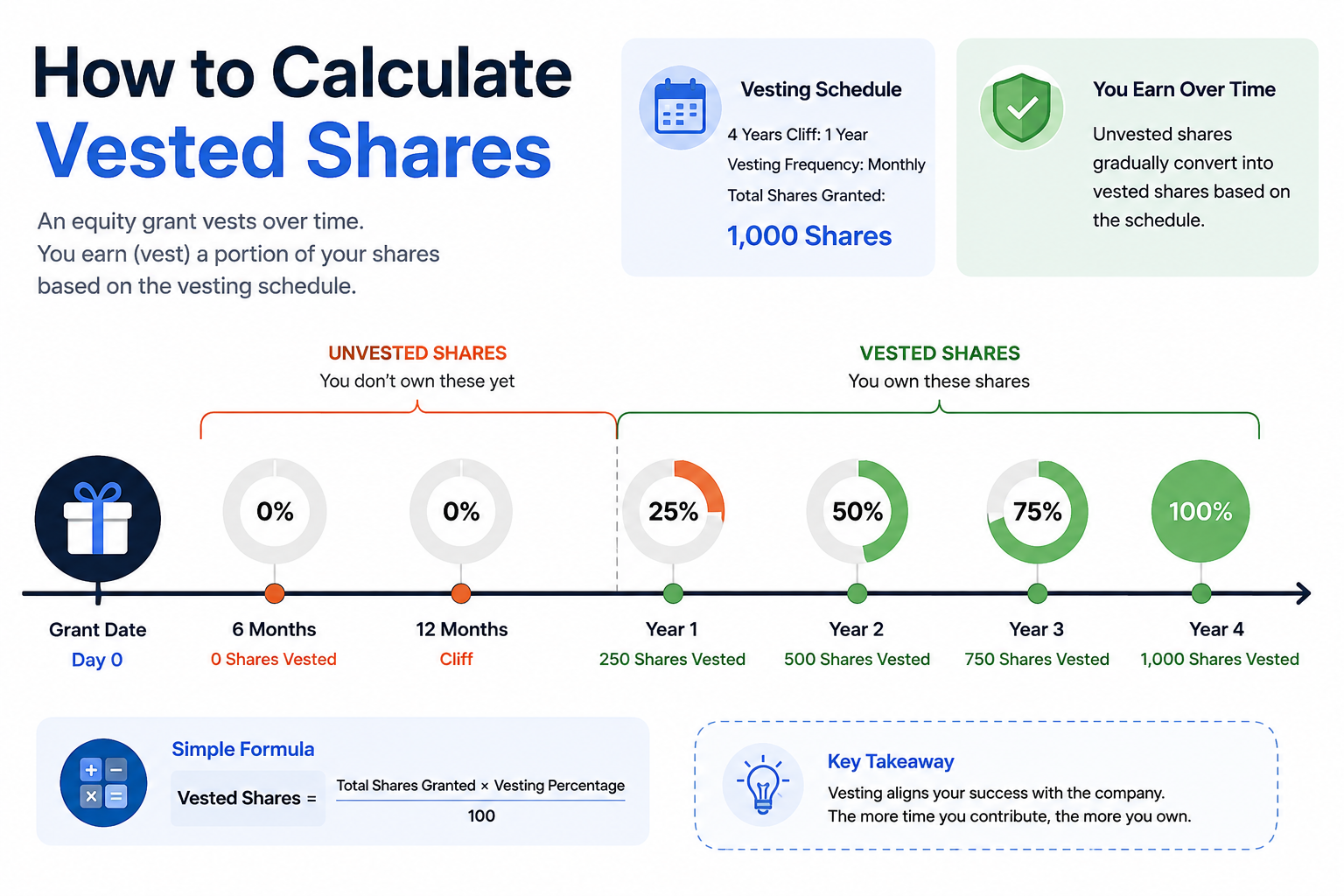
Vested shares are the portion of your equity grant that you’ve fully earned and own outright, based on the conditions in your vesting schedule. Until a share vests, it’s still just a promise on paper. Once it vests, it’s yours to keep even if you leave the company the next day (with some exceptions we’ll cover below).
Employers use vesting to encourage people to stay. A typical equity package, whether it’s restricted stock units (RSUs), stock options, or shares tied to an employee stock purchase plan, doesn’t hand over full ownership on day one. Instead, it releases ownership gradually over a set period, called the vesting period.
The Basic Formula for Calculating Vested Shares
At its core, calculating vested shares comes down to one relationship: how much time (or how many milestones) have passed, divided by the total vesting requirement, applied to your total grant.
For a straightforward graded schedule with no cliff, the formula looks like this:
Vested Shares = Total Granted Shares × (Time Elapsed ÷ Total Vesting Period)
For a schedule that includes a cliff (the far more common structure for RSUs and stock options), the formula splits into two parts:
Shares Vested at Cliff = Total Granted Shares × Cliff Percentage
Shares Vested After Cliff = (Remaining Shares ÷ Remaining Vesting Periods) × Completed Periods Since Cliff
Total Vested Shares = Shares Vested at Cliff + Shares Vested After Cliff
Important: These formulas assume a standard, evenly distributed vesting schedule. Your actual grant agreement is the final word. Some companies front-load or back-load vesting, and those schedules won’t follow a simple linear formula.
Vesting Schedule Types and How Each One Is Calculated
Before running any numbers, you need to know which type of vesting schedule applies to your grant. The calculation method changes depending on the structure.
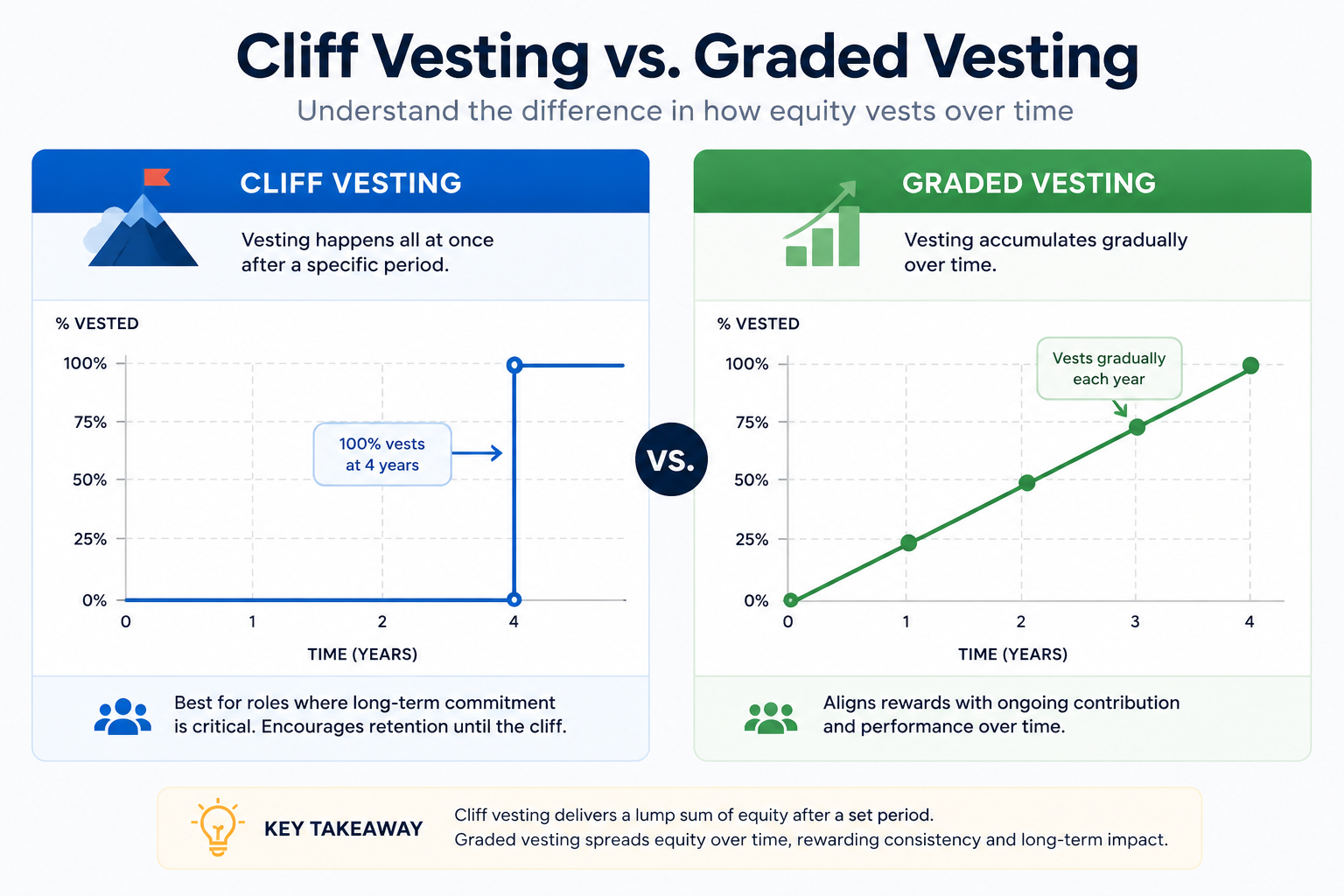
Cliff vesting releases 0% of your shares until a specific date, at which point a lump sum vests all at once. A 1-year cliff on a 4-year grant typically means 25% vests on your one-year anniversary, and nothing vests before that.
Graded (or ratable) vesting releases shares in smaller increments over the vesting period, usually monthly, quarterly, or annually, without a single large jump.
Immediate vesting means 100% ownership from the grant date. This is less common for employee equity but does appear in some director or advisor grants.
Milestone vesting ties share release to a specific event, such as a product launch, a revenue target, or an IPO, rather than the calendar. This type isn’t calculated with a formula at all since it depends on whether the milestone has been hit.
Most equity compensation packages in the US combine a cliff with graded vesting afterward. That hybrid structure is why the two-part formula above matters more than a single simple ratio.
Step-by-Step: How to Calculate Your Vested Shares
Follow these steps using the numbers from your own grant agreement.
Step 1: Find your grant date and total shares granted. This appears on your offer letter, stock option agreement, or RSU grant notice.
Step 2: Identify your vesting schedule type and length. Look for language like “4-year vesting with a 1-year cliff” or “36-month monthly vesting, no cliff.”
Step 3: Calculate your time elapsed. Count full months or years since the grant date, not since your general hire date if those differ.
Step 4: Apply the formula. If you’re past the cliff, calculate the cliff shares first, then add the graded portion earned since the cliff.
Step 5: Compare against your equity platform or pay stub. Most companies use a cap table or equity management platform that shows a running vested total. Use your manual calculation to double-check that number, not replace it.
Worked Example: RSUs With a Cliff and Monthly Vesting
Maria joined a mid-size tech company in Denver, Colorado on March 1, 2024. She was granted 4,800 RSUs on a standard 4-year vesting schedule with a 1-year cliff, vesting monthly after the cliff.
Step 1: Grant date is March 1, 2024. Total granted shares: 4,800.
Step 2: Schedule is 4 years (48 months), 1-year cliff, monthly vesting after.
Step 3: As of March 1, 2026, Maria has completed 24 months of service, which is 12 months past her cliff date.
Step 4: Applying the formula:
- Cliff shares: 4,800 × 25% = 1,200 shares vested at the 1-year mark (March 1, 2025)
- Remaining shares after cliff: 4,800 − 1,200 = 3,600 shares
- Remaining vesting periods: 36 months
- Monthly vesting rate: 3,600 ÷ 36 = 100 shares per month
- Shares vested since cliff: 100 × 12 completed months = 1,200 shares
Total vested shares as of March 1, 2026: 2,400 shares (50% of the grant).
Maria still has 2,400 unvested shares remaining, which will continue vesting at 100 shares per month over the next 24 months.
Worked Example: Stock Options With Quarterly Vesting
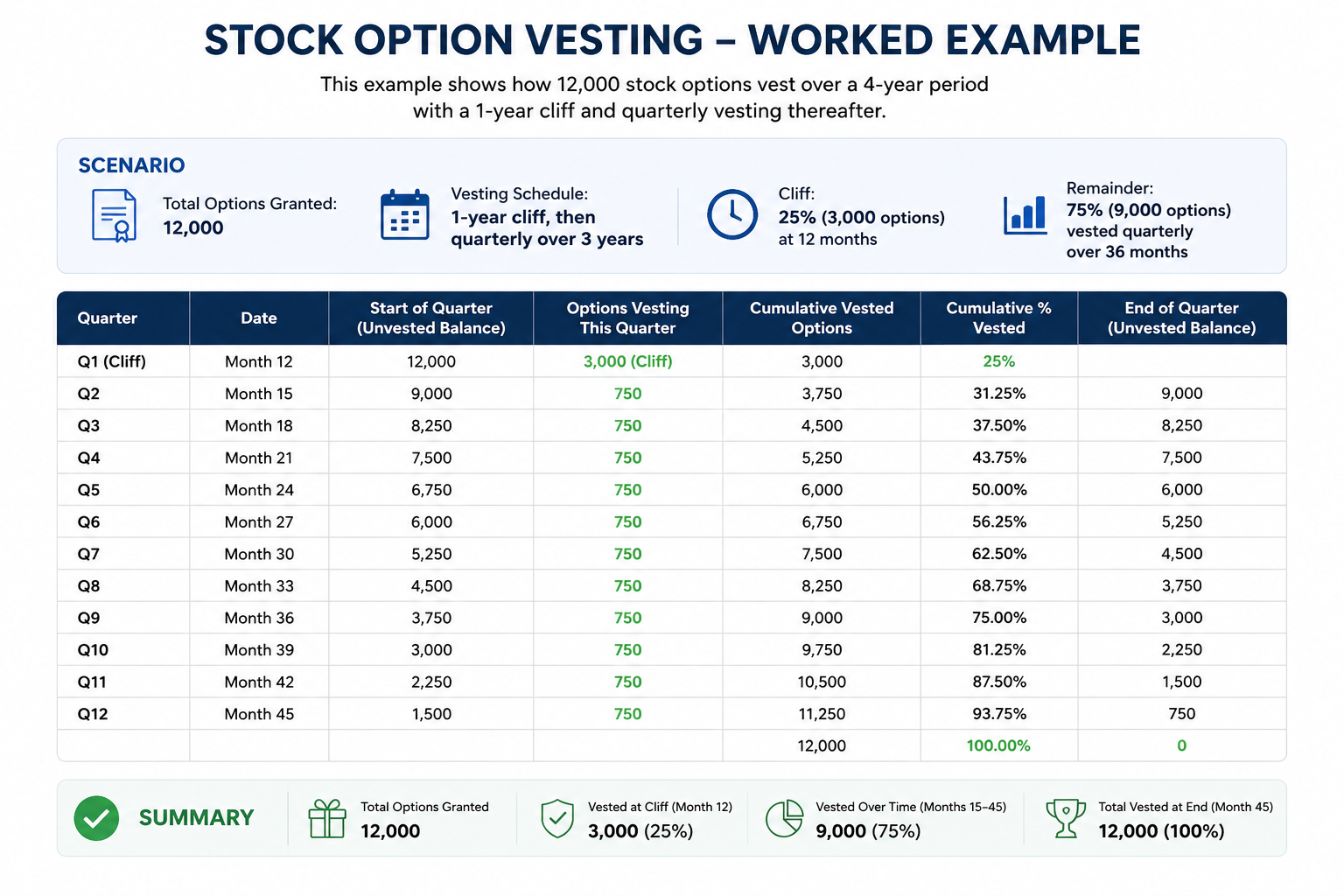
David works at an early-stage startup in Austin, Texas. He received a grant of 2,000 incentive stock options (ISOs) on June 15, 2023, vesting over 4 years with a 1-year cliff, and quarterly vesting after that.
Step 1: Grant date is June 15, 2023. Total granted options: 2,000.
Step 2: 4-year schedule, 1-year cliff, quarterly vesting after cliff (12 quarters remaining after the cliff).
Step 3: As of June 15, 2026, David has completed 3 full years, meaning 2 years (8 quarters) have passed since his cliff date.
Step 4: Applying the formula:
- Cliff shares: 2,000 × 25% = 500 options vested at the 1-year mark
- Remaining options after cliff: 2,000 − 500 = 1,500
- Remaining vesting periods: 12 quarters
- Quarterly vesting rate: 1,500 ÷ 12 = 125 options per quarter
- Options vested since cliff: 125 × 8 completed quarters = 1,000
Total vested options as of June 15, 2026: 1,500 options (75% of the grant).
Unlike RSUs, David’s vested options aren’t shares yet. He’ll need to exercise them, meaning pay the strike price set at grant, before he actually owns the underlying stock.
RSUs vs. Stock Options vs. ESPP: Vesting Comparison
| Feature | RSUs | Stock Options (ISO/NSO) | ESPP Shares |
|---|---|---|---|
| What vests | Actual shares | The right to buy shares at a fixed price | Purchase right at a discount, exercised on set dates |
| Cost to receive shares | None | Must pay the exercise (strike) price | Must pay the discounted purchase price |
| When taxed | At vesting, as ordinary income | Generally at exercise (NSOs) or sale (ISOs, if holding rules are met) | At sale, with ordinary income and capital gains components |
| Typical vesting structure | 4-year, 1-year cliff, then monthly or quarterly | 4-year, 1-year cliff, then monthly or quarterly | Offering periods, often 6 months, with no traditional cliff |
| IRS reporting form | W-2 wages | Form 3921 (ISO) or W-2 (NSO) | Form 3922 |
| Risk if company doesn’t grow | Still has value if vested and liquid | Can be worthless if strike price exceeds share value | Lower risk due to purchase discount |
Use the RSU Tax Calculator or the Employee Stock Option Calculator to translate your vested share count into an estimated after-tax dollar figure once you know how many shares you have.
How Vested Shares Are Taxed
Vesting and taxation are related but not identical events, and mixing them up is one of the most common errors people make.
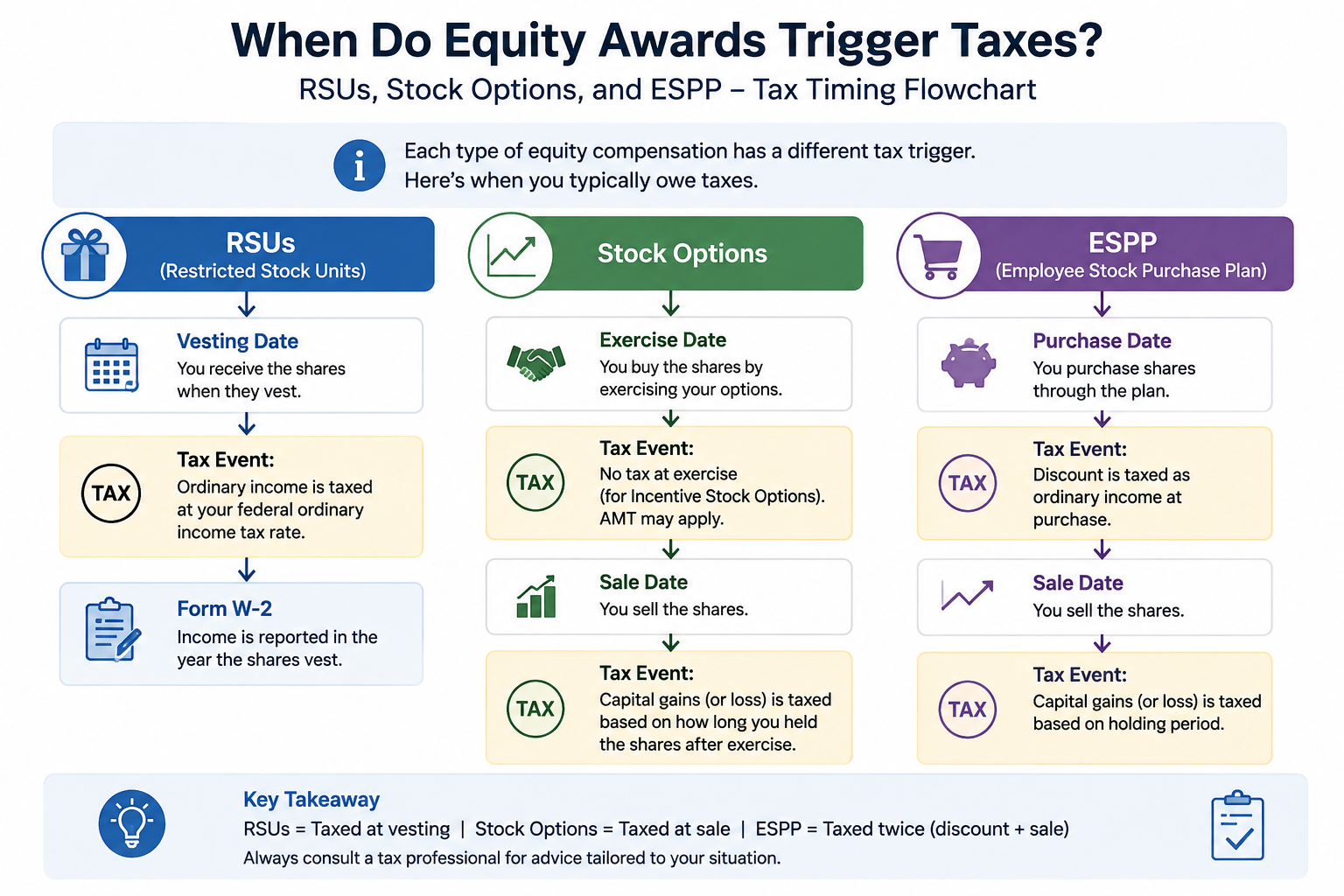
For RSUs, the taxable event is vesting itself. The fair market value of the shares on the vesting date is added to your W-2 as ordinary income, whether or not you sell the shares. If you later sell, any additional gain or loss is a capital gain or loss, and whether that’s short-term or long-term depends on how long you held the shares after vesting.
For stock options, vesting alone typically doesn’t trigger a tax bill. The taxable event is usually the exercise (for NSOs, the spread between strike price and fair market value is ordinary income) or, for ISOs, potentially the eventual sale, assuming holding period requirements are met. ISOs also carry Alternative Minimum Tax (AMT) exposure at exercise that’s worth reviewing with a tax professional before you exercise a large batch. Employers report ISO exercises on Form 3921.
For ESPP shares, taxation happens at sale, and the calculation depends on your purchase price, the discount you received, and how long you held the shares. Form 3922 documents the purchase details you’ll need.
Note: Federal tax treatment is consistent nationwide, but state tax treatment varies. If you moved between states during your vesting period, part of the income may be taxable in more than one state depending on each state’s sourcing rules. This is a case where a general calculator can’t give you a precise answer, and a tax professional familiar with multi-state equity compensation is worth the fee.
What Happens to Unvested Shares If You Leave
If you leave your job, resign, or are terminated before your grant is fully vested, the unvested portion is typically forfeited and returned to the company’s equity pool. What you keep is limited to whatever has already vested as of your last day.
For vested stock options, most companies give you a post-termination exercise period, commonly 90 days, to exercise before the options expire. Some companies now offer longer windows as an employee-friendly policy, so check your specific grant agreement rather than assuming 90 days applies.
For vested RSUs, there’s generally nothing further to do since the shares are already yours, though private companies sometimes use “double-trigger” vesting, where a liquidity event like an IPO or acquisition is required in addition to time-based vesting before shares are actually delivered.
Also worth noting: each grant runs on its own independent clock. If you received a second RSU or option grant a year or two after your first one, that second grant has its own vesting start date and cliff, separate from the first.
Common Mistakes to Avoid
- Using hire date instead of grant date. These are frequently different, especially if your equity grant was approved after your start date or as part of a later promotion or refresh.
- Forgetting the cliff resets nothing. A 1-year cliff doesn’t mean you get nothing for a year and then start over. It means the first 12 months of vesting all release at once on the cliff date.
- Confusing vesting with taxation for stock options. Vested options aren’t automatically taxed. You generally need to exercise them (and for ISOs, potentially hold them) before a tax consequence applies.
- Assuming partial years round the way you’d expect. Most plans only count completed months or years, not fractional service, unless the grant agreement specifically says otherwise.
- Relying on memory instead of the grant agreement. Verbal explanations from a manager or recruiter are not a substitute for the actual vesting terms in your signed agreement.
- Ignoring multiple grants. If you have several grants from different dates, each needs to be calculated separately rather than combined into one running total.
Glossary of Vesting Terms
- Vesting schedule: The timeline that governs when you earn ownership of granted equity.
- Cliff: An initial waiting period before any shares vest.
- Grant date: The date equity was officially awarded to you.
- Exercise price (or strike price): The fixed price you pay to purchase shares under a stock option grant.
- Unvested shares: Shares you’ve been granted but haven’t yet earned.
- Double-trigger vesting: A structure requiring both time-based vesting and a separate event, such as an IPO, before RSUs are delivered.
- 83(b) election: A tax election, generally relevant to restricted stock (not RSUs), that lets you pay tax on the value at grant instead of at vesting.
Key Takeaways
- Vested shares are the portion of your equity grant you’ve fully earned and own.
- The core formula splits into cliff shares plus graded shares earned since the cliff.
- Grant date, not hire date, is the anchor point for all vesting calculations.
- RSUs are taxed at vesting; stock options are typically taxed at exercise or sale.
- Unvested shares are usually forfeited if you leave before they vest.
- Vested stock options usually come with a limited exercise window after departure.
- Multi-state moves during your vesting period can complicate state tax treatment.
- A calculator gives you a strong estimate, but your signed grant agreement is the final authority.
FAQs
How do you calculate vested shares?
Multiply your total granted shares by the percentage of the vesting period completed. If there’s a cliff, calculate the cliff shares separately, then add shares earned during each vesting period after the cliff.
What is the formula for vested shares?
Total Vested Shares = Shares Vested at Cliff + (Monthly or Quarterly Vesting Rate × Completed Periods Since Cliff), where the vesting rate equals the remaining shares divided by the remaining vesting periods.
What is a 4-year vesting schedule?
It’s a timeline over which an employee earns 100% of a granted equity award across four years, most commonly with a 1-year cliff followed by monthly or quarterly vesting for the remaining three years.
How does a 1-year cliff work?
No shares vest during the first 12 months. On the 1-year anniversary of the grant date, the shares that would have vested during that first year (typically 25% of the total grant) vest all at once.
How many shares vest each month?
Divide the shares remaining after the cliff by the number of remaining vesting periods. For a standard 4-year grant with monthly vesting after a 1-year cliff, that’s the post-cliff share count divided by 36.
Can vested shares be sold?
Vested RSU shares generally can be sold once any company trading restrictions or blackout periods are lifted. Vested stock options must first be exercised, meaning purchased at the strike price, before the resulting shares can be sold.
What happens to unvested shares?
They’re typically forfeited and returned to the company’s equity pool if you leave before they vest, unless your agreement includes an acceleration clause tied to an acquisition or similar event.
What happens if I leave the company?
You generally keep whatever has already vested. Unvested shares are forfeited, and vested stock options usually come with a limited window, often 90 days, to exercise before they expire.
Are vested shares taxable?
RSUs are taxed as ordinary income at vesting, based on the shares’ fair market value that day. Stock options are typically taxed later, at exercise or sale, depending on whether they’re ISOs or NSOs.
How do RSUs vest?
RSUs vest according to the schedule in the grant agreement, most commonly a 4-year schedule with a 1-year cliff followed by monthly or quarterly vesting. Once vested, you own the shares outright with no purchase required.
Does a vesting schedule ever change after I sign my grant agreement?
It can, but only with your consent or under specific terms already written into your original agreement, such as an acceleration clause tied to an acquisition. A company generally can’t unilaterally lengthen or restructure your vesting after the fact.
Is a stock vesting calculator accurate for every company’s grant structure?
A standard calculator works well for typical cliff-plus-graded schedules, but front-loaded, back-loaded, or milestone-based grants require the specific terms in your agreement rather than a generic formula.
Conclusion
Learning how to calculate vested shares gives you a clear, verifiable answer to a question that otherwise depends on trusting whatever your HR portal or manager tells you. Whether you’re holding RSUs, stock options, or ESPP shares, the same core idea applies: total shares, split between what a cliff releases at once and what vests gradually afterward. Once you know your grant date, schedule type, and total shares, you can run the math yourself and confirm it against your company’s equity platform.
If you want the math done for you, plug your own grant details into our vesting schedule calculator to see your exact vested total, or use our RSU Tax Calculator to estimate what you’d owe once those shares vest.
References
- IRS.gov, Restricted Stock Units and Other Equity-Based Compensation
- IRS.gov, About Form 3921, Exercise of an Incentive Stock Option
- IRS.gov, About Form 3922, Transfer of Stock Acquired Through an Employee Stock Purchase Plan
- SEC.gov / Investor.gov, Employee Stock Options
This article is for educational purposes only and does not constitute financial or tax advice. Vesting terms vary by company and grant agreement. Consult a qualified tax professional or financial advisor before making decisions based on your equity compensation.