
If your offer letter has an equity line on it, there’s a good chance it says either “RSUs” or “stock options,” and the two are not interchangeable. In the RSU vs stock options decision, you’re really choosing between two different bets: guaranteed shares you didn’t have to pay for, or the right to buy shares later at today’s price. One is close to a bonus paid in stock. The other is closer to a lottery ticket with decent odds.
Both are forms of employee equity compensation, and both can meaningfully grow your net worth over a career. But they behave differently in nearly every way that matters: when you owe tax, how much risk you’re carrying, what happens if you quit, and how much upside is actually on the table.
In this guide, you’ll learn:
- What RSUs are and how they vest
- What stock options are, including the difference between ISOs and NSOs
- How the IRS taxes each one, with the forms involved
- A side-by-side comparison table and a worked numeric example
- Which one tends to make more sense depending on your situation
- Common mistakes people make with each type of equity
- How to think about equity when negotiating a job offer
Table of Contents
- What Are RSUs?
- What Are Stock Options?
- RSU vs Stock Options: Key Differences
- RSU vs Stock Options Tax Implications
- A Worked Example: Same Grant Value, Three Outcomes
- RSU vs Stock Options for Startups vs Public Companies
- RSU Benefits and Stock Option Benefits, Side by Side
- Which One Is Better for You?
- Who This Decision Isn’t Really About
- Common Mistakes to Avoid
- Negotiating Equity Into a Job Offer
- Glossary
- Key Takeaways
- FAQs
- Conclusion
What Are RSUs?
A Restricted Stock Unit, or RSU, is a company’s written promise to hand you a set number of shares once you satisfy certain conditions, usually tied to time and sometimes to a performance or liquidity event. You don’t buy anything. You don’t sign a check. You just wait out the vesting schedule, and when a batch vests, the shares land in your brokerage account.
Most RSU grants vest over four years, often with 25% vesting after the first year (sometimes called a one-year cliff) and the rest vesting monthly or quarterly after that. If you’re granted 2,000 RSUs on a standard four-year schedule with a one-year cliff, you’d receive 500 shares at the one-year mark, then smaller batches every quarter or month afterward.
Because RSUs convert to actual shares once vested, they always carry some value as long as the stock price is above zero. That’s the core appeal: no strike price, no risk of the grant going “underwater,” and a much simpler mental model than options.
Private companies frequently attach a second condition to RSUs, commonly called a double-trigger. Under a double-trigger structure, your RSUs vest only after both the time-based schedule is satisfied and the company has a liquidity event, such as an IPO or acquisition. This protects employees from owing tax on stock they can’t yet sell, which is a real risk with single-trigger RSUs at a private company.
What Are Stock Options?
A stock option gives you the right, not the obligation, to buy a set number of company shares at a fixed price, called the strike price or exercise price, generally set at the stock’s fair market value on the date the option was granted. You still have to exercise the option (pay the strike price) to actually own shares, and you can do that any time after vesting and before the option expires.
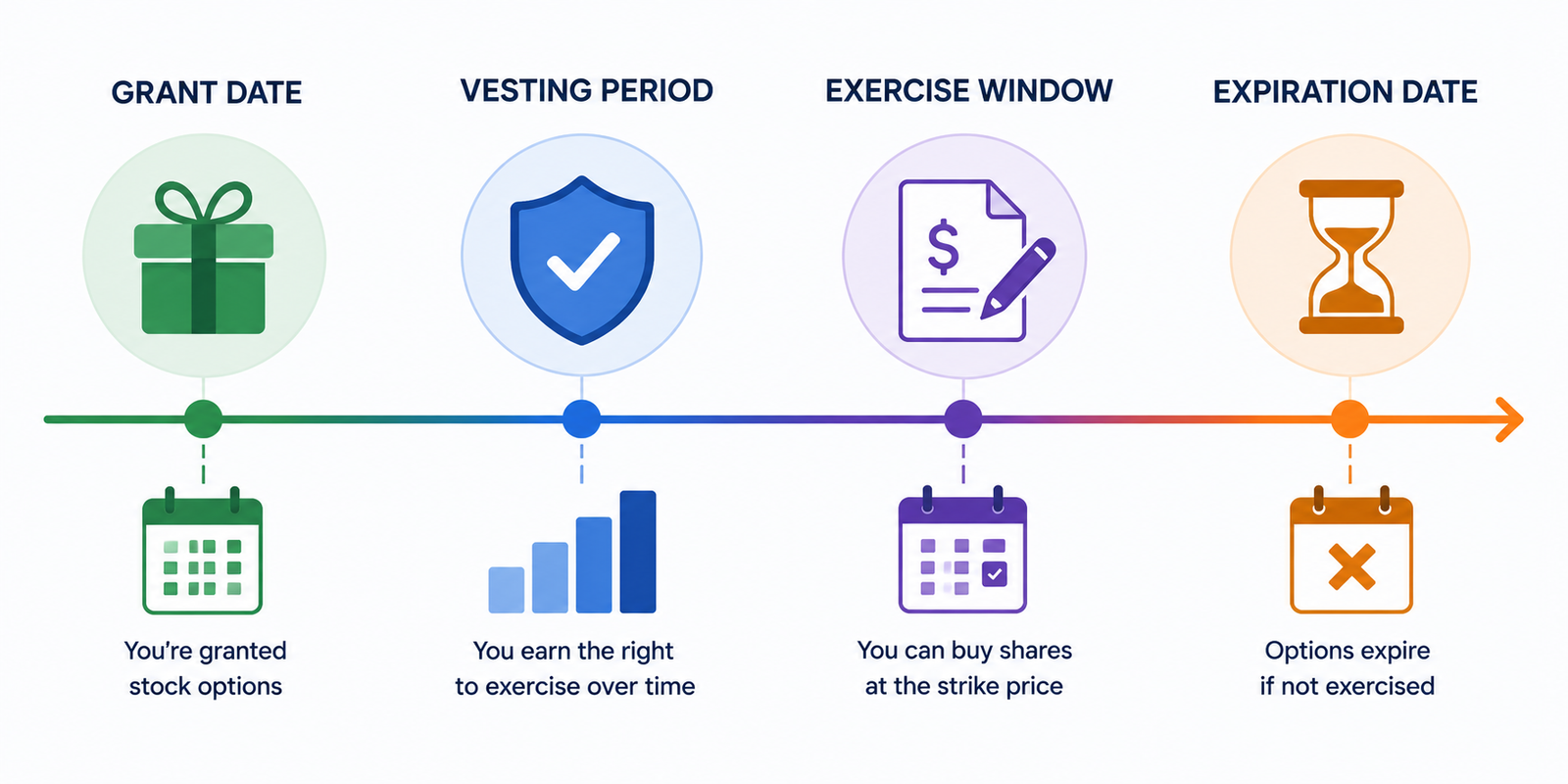
The math only works in your favor if the stock’s current value is above the strike price. If a company’s shares are trading below the strike price, the options are described as underwater, and exercising them would mean paying more than the shares are worth.
Stock options come in two flavors, and the difference matters enormously for taxes:
Incentive Stock Options (ISOs) can only be granted to employees, not contractors or advisors. ISOs offer the possibility of more favorable tax treatment if you meet specific IRS holding-period rules, but they also carry Alternative Minimum Tax (AMT) risk when you exercise and hold the shares.
Non-Qualified Stock Options (NSOs) can be granted to employees, contractors, board members, and advisors. NSOs are taxed as ordinary income on the spread between your strike price and the stock’s fair market value at the moment you exercise.
Options typically expire 10 years from the grant date, and if you leave the company, you’ll usually have a short post-termination window, often around 90 days, to exercise any vested options before they’re forfeited. Unvested options are almost always forfeited immediately upon departure.
RSU vs Stock Options: Key Differences
| Feature | RSUs | Stock Options |
|---|---|---|
| What you receive | Actual shares, delivered at vesting | The right to buy shares at a fixed strike price |
| Upfront cost | None | You pay the strike price to exercise |
| Value if stock drops | Still worth something as long as price is above $0 | Can go to $0 in value (underwater) |
| Taxed when | At vesting, as ordinary income | At exercise (NSOs) or potentially at sale (ISOs, if holding rules are met) |
| Reported on | W-2 | W-2 (NSOs) or Form 3921 (ISOs) |
| Expiration | Typically none once vested; you own the shares | Usually 10 years from grant |
| Upside potential | Grows with the stock, but starts from a known base | Can be larger in percentage terms if the company grows a lot |
| Most common at | Public companies, late-stage private companies | Early- and mid-stage startups |
Note: RSUs and stock options are sometimes lumped together with an ESOP (Employee Stock Ownership Plan), but an ESOP is technically a different structure, a qualified retirement plan that holds company stock in trust for employees. Most tech and startup “equity compensation” you’ll hear about is RSUs or options, not a formal ESOP.
RSU vs Stock Options Tax Implications
This is where the two diverge the most, and where the biggest financial mistakes happen.
How RSUs are taxed
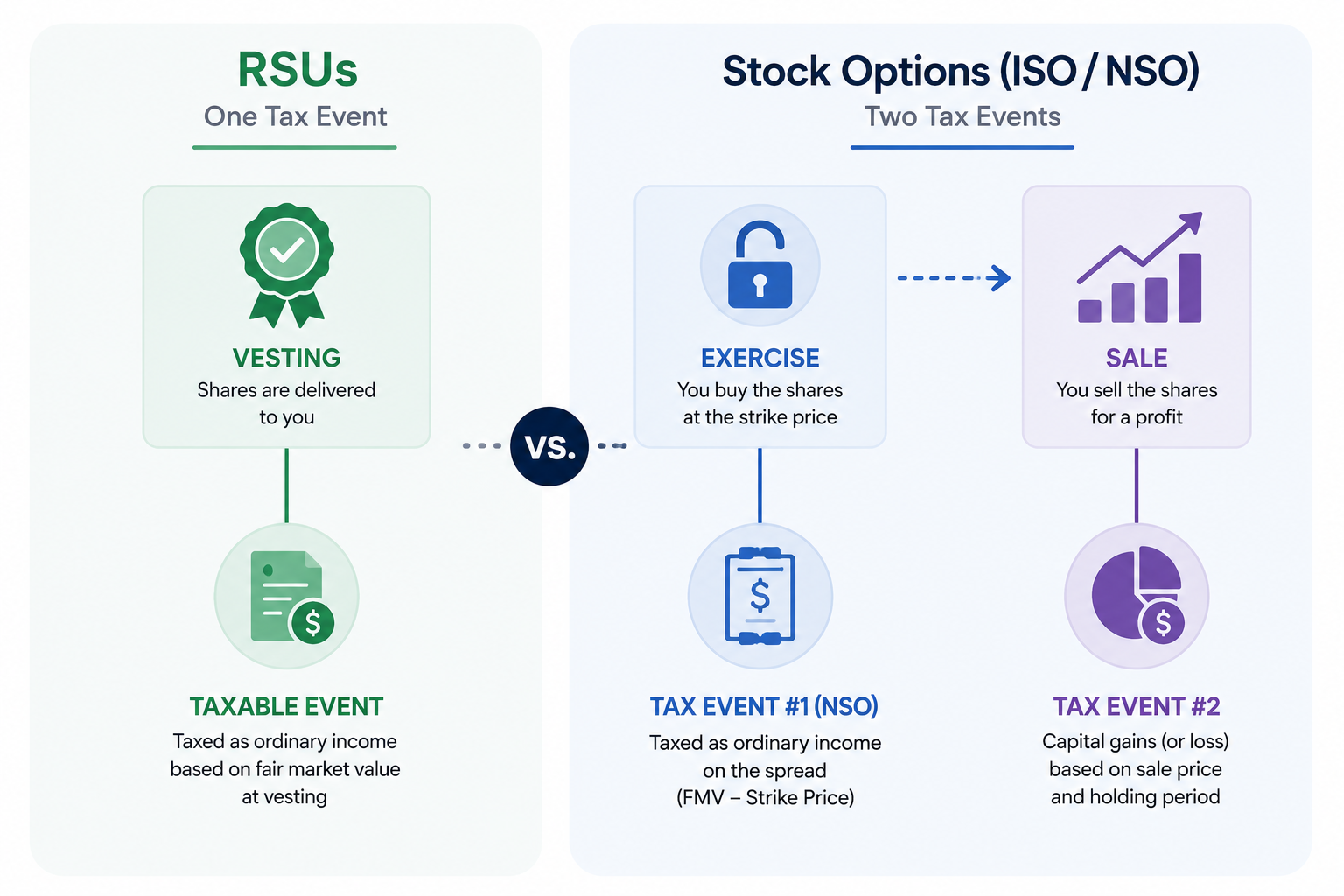
When RSUs vest, the fair market value of the shares on that date is treated as ordinary income and added to your W-2, subject to federal income tax withholding, Social Security, and Medicare. Your employer typically covers the withholding by holding back a portion of the vesting shares (called “sell to cover”) or by withholding cash from your paycheck.
If you hold the shares after vesting and later sell them for more than their value at vesting, that additional gain is a capital gain. Sell within a year of vesting and it’s short-term (taxed at ordinary income rates); hold more than a year and it’s long-term (generally taxed at lower capital gains rates).
How stock options are taxed
For NSOs, you owe ordinary income tax on the spread between the strike price and the fair market value on the day you exercise, whether or not you sell the shares right away. Sell later, and any additional gain or loss is a capital gain or loss.
For ISOs, there’s typically no regular income tax due at exercise, but the spread between the strike price and fair market value can trigger the Alternative Minimum Tax if you exercise and hold the shares past year-end. To get favorable long-term capital gains treatment on the entire gain, the IRS generally requires you to hold ISO shares for at least two years from the grant date and at least one year from the exercise date. Sell before meeting both holding periods, and it becomes a “disqualifying disposition,” taxed more like an NSO.
Important: If you pay AMT because of an ISO exercise, you may be eligible for an AMT credit in future tax years that offsets regular tax you’d otherwise owe. This credit is easy to miss and often requires a tax professional or dedicated software to track correctly.
Forms you’ll actually see
Employers report ISO exercises on Form 3921 and NSO exercises typically flow through your W-2. Employee Stock Purchase Plan (ESPP) purchases, if your company also offers one, get reported on Form 3922. Keep both forms; you’ll need the cost-basis information they contain when you eventually sell and file Schedule D.
Don’t forget state tax, and NIIT
Federal tax rules are the same everywhere, but state income tax on RSU vesting or option exercise depends entirely on where you live and, in some cases, where you worked when the equity was earned. If you moved between states during your vesting period, you could owe tax to more than one state on the same grant. There’s no way to give a single number here since state rates and rules vary; this is one area where a tax professional familiar with equity compensation earns their fee.
High earners should also be aware that capital gains from selling vested RSU shares or exercised option shares can be subject to the 3.8% Net Investment Income Tax on top of regular capital gains tax, depending on total income for the year.
A Worked Example: Same Grant Value, Three Outcomes
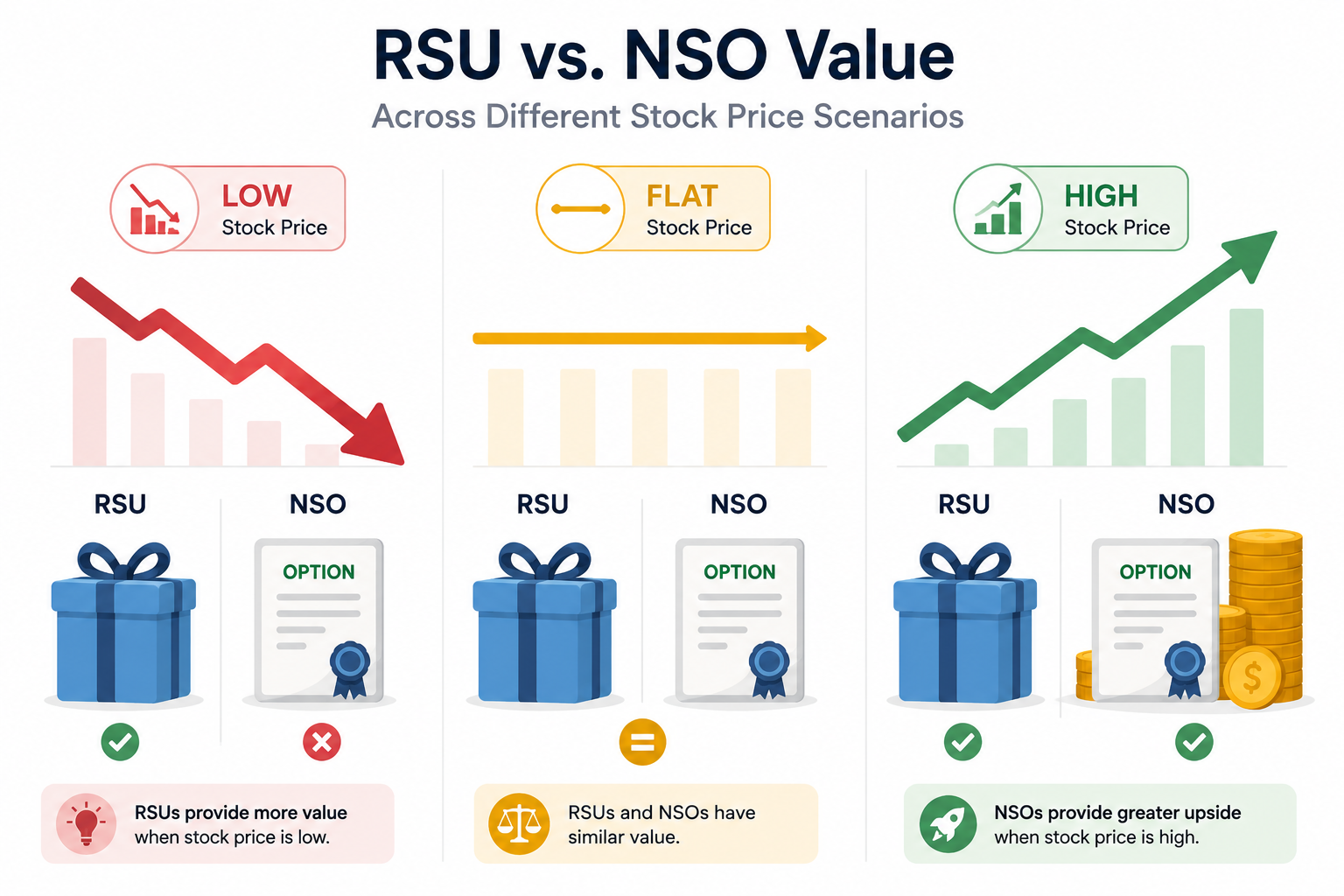
Numbers make this easier to picture. Suppose you’re offered equity worth $40,000 at grant, and you’re comparing an RSU grant to an NSO grant with a $10 strike price (so 4,000 options), assuming the stock is at $10 when granted.
| Stock price at your decision point | RSU value (4,000 shares) | NSO value after paying strike price (4,000 options) |
|---|---|---|
| Stock drops to $5 | $20,000 | $0 (underwater, no reason to exercise) |
| Stock stays at $10 | $40,000 | $0 (no spread, breakeven before tax) |
| Stock rises to $25 | $100,000 | $60,000 (($25-$10) × 4,000 shares) |
This is the simplest way to see the risk-reward tradeoff. RSUs hold value all the way down; options can be worth nothing at the same stock price where RSUs still have meaningful value. But once the stock climbs meaningfully above the strike price, options can produce a larger percentage gain relative to what the company “spent” to grant them, which is part of why fast-growing early-stage companies lean on them.
RSU vs Stock Options for Startups vs Public Companies
Early-stage startups tend to lean on stock options because their share price is low and the potential upside is large, so options let a company offer meaningful long-term incentive without a large accounting expense today or a big cash outlay from employees at grant. As companies mature, typically around later private funding rounds or as an IPO becomes realistic, many shift toward RSUs. At that point, the 409A valuation used to set the strike price has usually risen enough that exercising options becomes expensive, and RSUs remove that friction since there’s no purchase required.
This isn’t a hard rule. Some late-stage private companies still grant options to certain roles, and some earlier companies use RSUs for senior hires who want more certainty. But as a general pattern, expect options at an early-stage startup and RSUs once you’re talking to a public company or a well-funded, later-stage private one.
RSU Benefits and Stock Option Benefits, Side by Side
RSU benefits:
- No purchase required and no risk of the grant going to $0 in value
- Simpler to understand and track
- Predictable number of shares, so it’s easier to estimate what a grant is worth
- Works well when you want equity compensation to behave more like a bonus
Stock option benefits:
- Greater percentage upside if the company’s value grows substantially
- More control over timing, since you decide when to exercise (within the option’s life)
- ISOs offer a path to long-term capital gains treatment on the full gain if holding rules are met
- Lower dilution cost to the company can sometimes mean larger option grants than equivalent-value RSU grants
Which One Is Better for You?
Most employees don’t actually get to choose since the company sets its equity program and you’re offered whichever it uses. But when you do have a choice, or when you’re comparing offers from two companies that use different structures, a few questions help:
RSUs tend to make more sense when:
- The company is public or has a credible, near-term path to liquidity
- You’d rather not tie up cash to exercise anything
- You want a form of equity compensation that behaves predictably
- You’re risk-averse about your equity being worth $0
Stock options tend to make more sense when:
- You’re joining an early-stage company with real, if uncertain, growth potential
- You have the cash on hand to exercise and can absorb the risk if the bet doesn’t pay off
- You’re comfortable managing AMT and holding-period rules, or working with someone who can
- You want more control over when you trigger a taxable event
Who This Decision Isn’t Really About
If you’re weighing a job offer purely because the equity number on the offer letter looks impressive, it’s worth remembering that unvested RSUs and unexercised options are not the same as cash in the bank. Someone who needs stable, predictable take-home pay in the near term, who is not in a position to absorb a stock price drop, or who can’t spare cash to exercise options, should weight the base salary and near-term liquidity of an offer more heavily than the headline equity value, regardless of which type is offered.
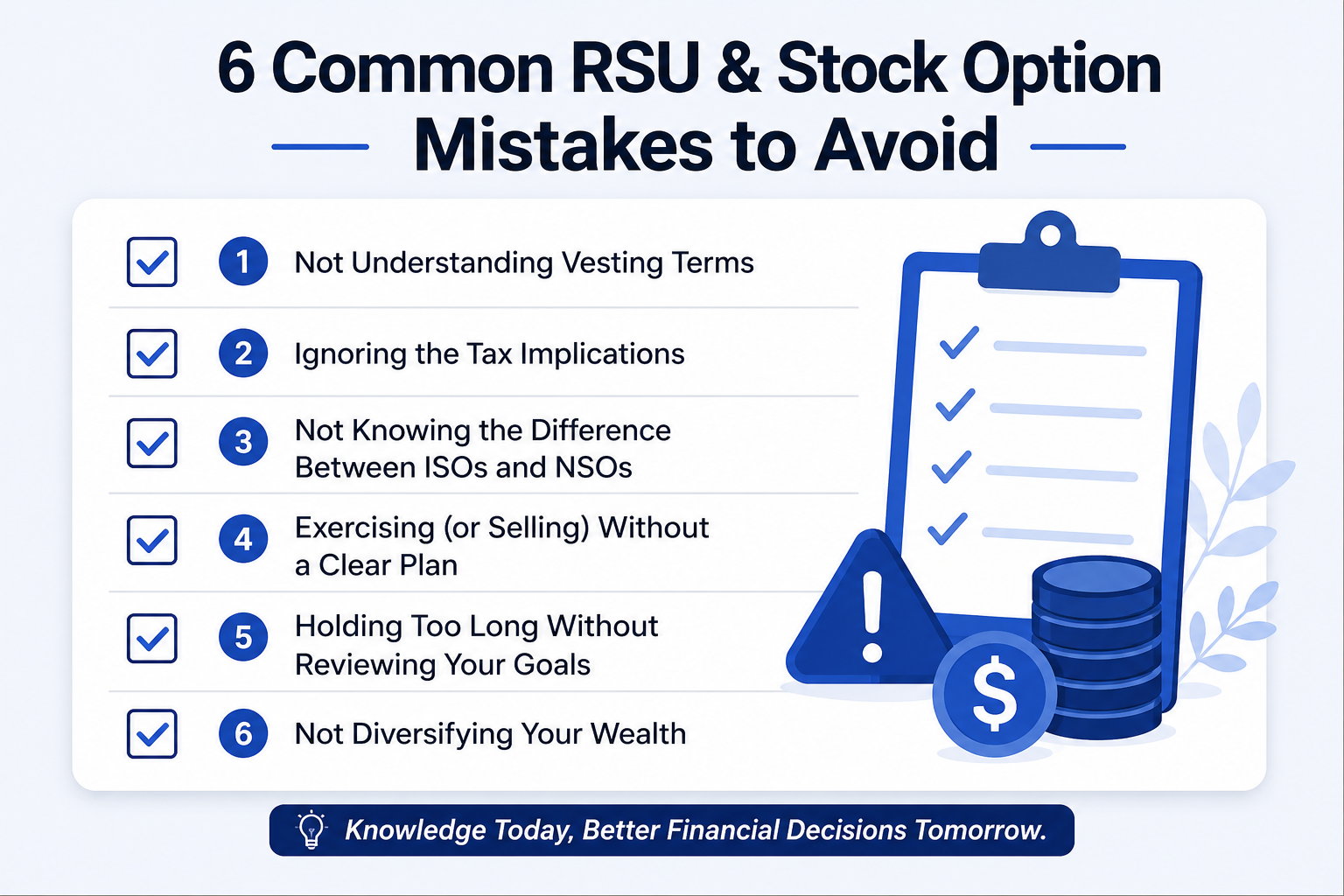
Common Mistakes to Avoid
- Not budgeting for the RSU tax bill. RSUs are taxed as ordinary income at vesting whether or not you sell, and default withholding rates sometimes undershoot what you’ll actually owe, especially for large vests.
- Letting vested options expire. Whether it’s the standard 10-year expiration or the shorter post-termination window after you leave a job, missing the deadline means forfeiting value you already earned.
- Concentrating too much net worth in one stock. Holding a large position in your employer’s shares, on top of your salary already depending on that same company, adds concentration risk that’s easy to underestimate.
- Confusing ISOs and NSOs. The tax treatment is different enough that mixing them up in your planning can lead to a surprise AMT bill or a missed holding-period deadline.
- Ignoring the 83(b) election window for early-exercised options. If your option grant allows early exercise before full vesting, filing an 83(b) election with the IRS within 30 days of exercise can start your long-term capital gains clock sooner, but miss that 30-day window and the option disappears entirely.
- Assuming a double-trigger RSU at a private company means you’re already a shareholder. Until both triggers are met, there’s no taxable event and, more importantly, no liquidity, even though the shares may show up on a cap table statement.
Negotiating Equity Into a Job Offer
If two offers put similar dollar values on their equity but use different structures, don’t treat the numbers as directly comparable. An RSU-heavy offer at a public company is closer to deferred cash. An option-heavy offer at a private startup is a bet on a specific outcome, an eventual sale or IPO at a share price meaningfully above your strike price. Ask what the current 409A valuation or last funding round valuation is, how many shares are outstanding (so you can estimate your actual ownership percentage), and what the vesting schedule and any acceleration triggers look like if the company is acquired.
A Share Incentive Plans Calculator or RSU Tax Calculator can help translate a grant into a rough after-tax number so you’re not just comparing raw share counts between offers.
Glossary
- Vesting: The process of earning the right to shares over time or upon meeting a condition
- Strike price / exercise price: The fixed price at which you can buy shares under an option
- Underwater: When an option’s strike price is higher than the stock’s current value
- 409A valuation: An independent appraisal of a private company’s common stock, used to set option strike prices
- Double-trigger vesting: A structure requiring both a time-based condition and a liquidity event before shares vest
- AMT (Alternative Minimum Tax): A parallel tax calculation that can apply when you exercise and hold ISOs
- Disqualifying disposition: Selling ISO shares before meeting the required holding periods, losing favorable tax treatment
Key Takeaways
- RSUs deliver actual shares at vesting with no purchase required; stock options give you the right to buy shares at a fixed strike price.
- RSUs are taxed as ordinary income the moment they vest. Stock options are taxed at exercise (NSOs) or potentially deferred with AMT risk (ISOs).
- RSUs hold value as long as the stock price is above zero. Options can become worthless if the stock drops below the strike price.
- Startups tend to favor options early on and shift to RSUs as they mature or approach an IPO.
- ISOs and NSOs are taxed very differently; know which type you hold before making exercise decisions.
- State income tax and the Net Investment Income Tax can both add to your total bill and vary based on your personal situation.
- Vested options usually must be exercised within a short window after you leave a job, commonly around 90 days.
- Neither RSUs nor options should be treated as guaranteed cash when evaluating a job offer.
FAQs
What is the main difference between RSUs and stock options?
RSUs give you shares outright once they vest, with no purchase required. Stock options give you the right to buy shares at a fixed strike price, and you only benefit if the stock’s value rises above that price.
What is an RSU in simple terms?
An RSU is a company’s promise to give you a set number of shares once you meet certain conditions, usually tied to how long you’ve worked there.
What are stock options in simple terms?
Stock options let you buy company shares later at a price set today, so you benefit if the stock’s value grows above that price.
RSU or stock options, which is better?
Neither is universally better. RSUs offer more certainty and less risk; stock options offer more potential upside with more risk and more tax complexity.
How are RSUs taxed differently than stock options?
RSUs are taxed as ordinary income when they vest. NSOs are taxed as ordinary income when exercised. ISOs may avoid regular income tax at exercise but can trigger AMT, with capital gains tax applying at sale if holding rules are met.
Do I need cash to receive RSUs?
No. RSUs require no payment; you simply receive shares when they vest.
Do I need cash to exercise stock options?
Yes, unless your plan allows a cashless exercise, you need to pay the strike price multiplied by the number of options you’re exercising.
What happens to my equity if I quit?
Unvested RSUs and unvested options are both typically forfeited. Vested RSU shares are yours to keep. Vested options usually must be exercised within a short window, often around 90 days, or they’re forfeited too.
Can RSUs lose all their value?
RSUs retain some value as long as the underlying stock trades above $0, though a falling stock price still reduces what your shares are worth.
Why do some private companies use double-trigger RSUs instead of standard vesting?
Double-trigger RSUs protect employees from owing tax on shares they can’t yet sell, since the second trigger, usually a liquidity event, has to occur before the shares (and the tax bill) become real.
Is an ESPP the same as RSUs or stock options?
No. An Employee Stock Purchase Plan lets you buy company stock, often at a discount, through payroll deductions. It’s a separate benefit from RSU or option grants, though some companies offer all three.
How does the 83(b) election relate to stock options?
An 83(b) election applies when you early-exercise unvested options (or receive restricted stock directly). Filing it within 30 days of exercise lets you start your capital gains holding period immediately rather than at each future vesting date, but the 30-day IRS deadline is strict and non-negotiable.
Conclusion
The RSU vs stock options decision ultimately comes down to how much certainty you want versus how much upside you’re willing to chase. RSUs behave like a predictable slice of compensation that arrives as shares instead of cash, taxed the moment they vest. Stock options are a bet with real risk and real tax complexity, but with the potential for a much bigger payoff if the company’s value climbs well above your strike price.
Whichever type of equity compensation your offer includes, run the numbers before you sign anything, understand the tax timing, and don’t let unvested shares or unexercised options change how you budget today. If you want to see how a specific grant plays out after tax, our RSU Tax Calculator and Share Incentive Plans Calculator can help you model it before you decide.
References
- IRS: Topic No. 427, Stock Options
- IRS: Instructions for Forms 3921 and 3922
- IRS: About Form 6251, Alternative Minimum Tax – Individuals
- IRS: Topic No. 409, Capital Gains and Losses
- SEC: Employee Benefit Plans, Rule 701
This article is for educational purposes only and does not constitute financial or tax advice. Please consult a qualified financial advisor or tax professional regarding your specific situation.