
If you’re weighing a job change, you’ve probably asked yourself what happens to stock options when you leave a company. It’s a fair question, and the answer can affect your bank account far more than most people expect. Vested options usually stay yours, but only if you act inside a strict deadline. Unvested options almost always disappear the moment you walk out the door.
This guide breaks down what actually happens to your equity after you resign, get laid off, retire, or are let go, and what you should check before you give notice.
In this guide, you’ll learn:
- The difference between vested and unvested stock options after resignation
- How the post termination exercise period works and why the 90-day window matters
- What changes for ISOs versus NSOs once you’re no longer employed
- How quitting, being fired, layoffs, and retirement each affect your equity differently
- What happens to RSUs and ESPP shares when you leave
- The tax forms and rules you’ll run into if you exercise stock options after resignation
Table of Contents
- What Are Stock Options, Exactly?
- Vested vs. Unvested Stock Options: The Core Difference
- What Happens to Vested Stock Options When You Leave
- What Happens to Unvested Stock Options When You Leave
- The Post Termination Exercise Period, Explained
- What Changes for ISOs vs. NSOs Once You Leave
- How Your Reason for Leaving Changes the Outcome
- What About RSUs and ESPP Shares?
- Tax Implications of Exercising Stock Options After You Leave
- Private Company vs. Public Company Considerations
- Steps to Take Before You Give Notice
- Common Mistakes to Avoid
- Key Takeaways
- Frequently Asked Questions
- Conclusion
What Are Stock Options, Exactly?
A stock option is not a share of stock. It’s the right to buy a share later at a fixed price, called the strike price or exercise price. If your company’s stock rises above that price, exercising the option lets you buy low and hold something worth more.
Say your strike price is $8 and the shares are now worth $20. Exercising 1,000 options means paying $8,000 to receive stock worth $20,000 on paper. That $12,000 gap is called the spread, and it matters a lot for taxes, which we’ll get to later.
Companies grant two main types of stock options in the US: incentive stock options (ISOs) and non-qualified stock options (NSOs). Restricted stock units (RSUs) and employee stock purchase plans (ESPPs) are related but structurally different forms of equity compensation, and we’ll cover both separately since leaving a company treats them differently too.
Quick glossary: Strike price (the fixed purchase price in your grant), vesting (earning the right to your shares over time), exercise (actually buying the shares at the strike price), PTEP (the window you have to exercise after leaving), and spread (the gap between strike price and current fair market value).
Vested vs. Unvested Stock Options: The Core Difference
Vesting is how a company ties equity to time spent at the job. Most option grants use a four-year schedule with a one-year cliff. That means you earn nothing for the first twelve months, then a chunk vests all at once, followed by monthly or quarterly vesting for the rest of the term.
Vesting Schedule Example
| Tenure at departure | Vested options (out of a 4,000-option grant) |
|---|---|
| Less than 1 year | 0 |
| 1 year (cliff) | 1,000 |
| 2 years | 2,000 |
| 3 years | 3,000 |
| 4 years | 4,000 |
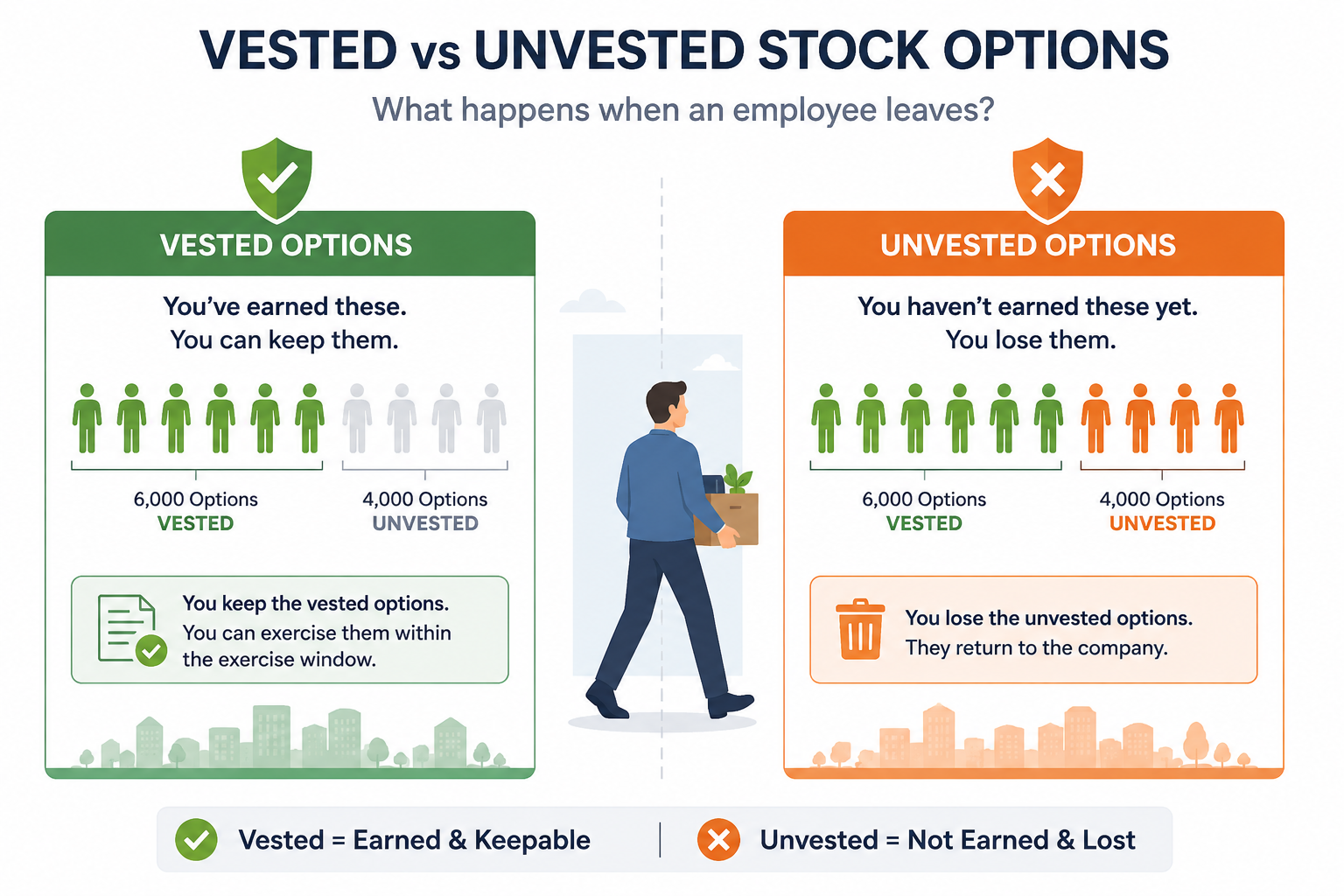
Vested options belong to you in the sense that you’ve earned the right to buy them. Unvested options are still a promise, not a possession. Leave before your cliff and you typically walk away with nothing from that grant.
If you’re close to a vesting date, it’s worth running the numbers with a stock options calculator before deciding on your last day. A few extra weeks can sometimes mean thousands of dollars in additional vested shares.
What Happens to Vested Stock Options When You Leave
Vested stock options after leaving a company generally remain yours to exercise, but only within a set window. Once your employment ends, the clock starts, and if you don’t exercise before it runs out, those options expire worthless, even if they were deep in the money.
This is the single most common source of regret among people who’ve already left a job. The grant’s original expiration date, often ten years from the grant date, almost never applies once you’re no longer employed. A separate, much shorter deadline takes over.
What Happens to Unvested Stock Options When You Leave
Unvested stock options are forfeited when you leave, in the vast majority of cases. That’s the entire point of vesting: it rewards people who stay. If you quit two years into a four-year grant, the remaining two years of options simply disappear.
There are exceptions. Some executive agreements include accelerated vesting tied to specific triggers, most commonly a company acquisition. A single-trigger clause vests unvested equity immediately upon that event. A double-trigger clause requires both the acquisition and a qualifying termination, such as a layoff, before acceleration kicks in. These provisions are rare outside of leadership-level grants, so check your agreement rather than assume you have one.
The Post Termination Exercise Period, Explained
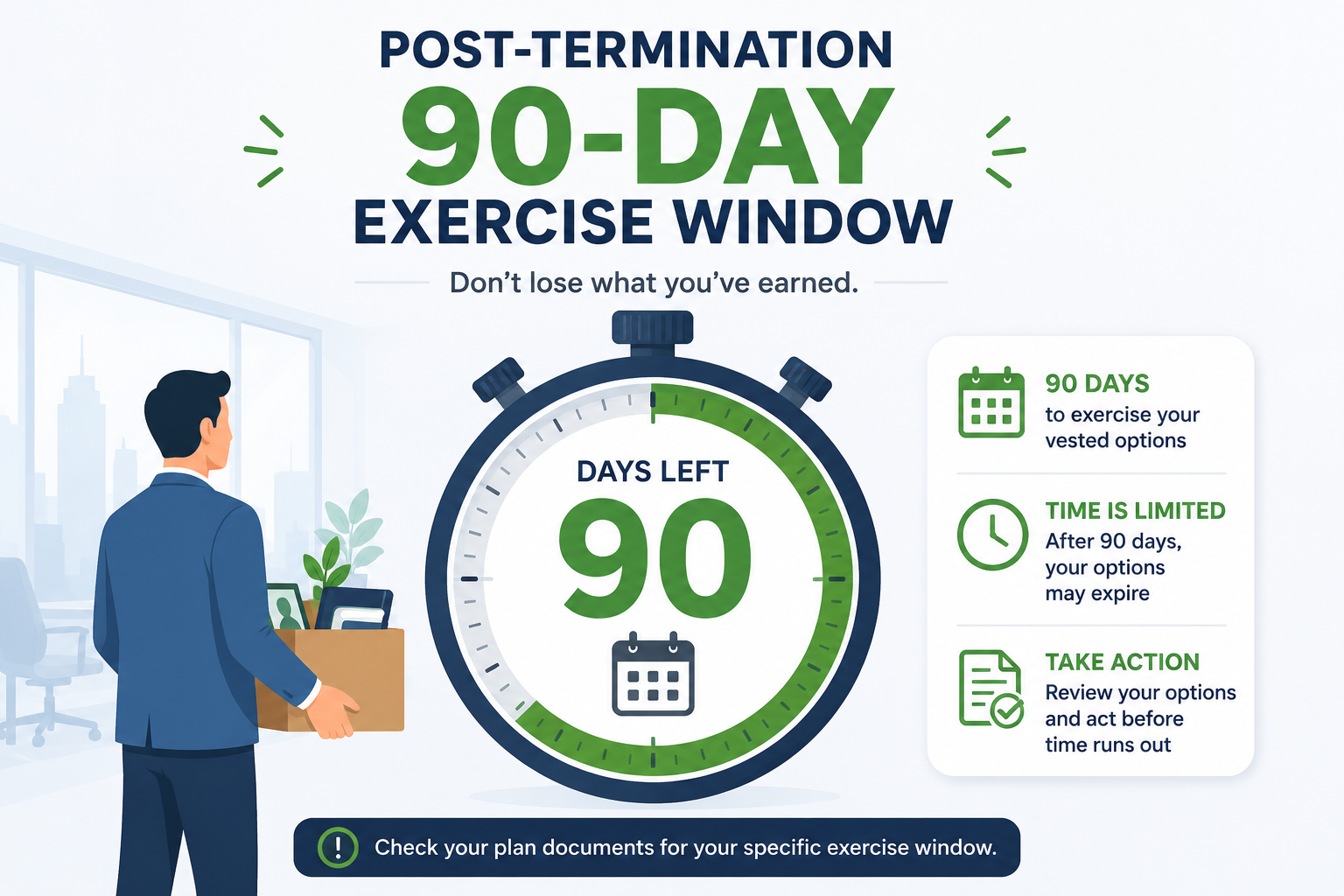
The post termination exercise period, or PTEP, is the amount of time you get to exercise your vested options after your last day. Ninety days is the most common length, largely because it lines up with the IRS rule for ISOs, but some companies set 30 days, some set a full year, and a growing number of later-stage private companies extend it to several years.
A Worked Example
Say your last day is October 1 and your plan sets a 90-day PTEP. Your deadline lands around December 30. If you have 2,000 vested options with an $8 strike price, exercising all of them costs $16,000 before taxes. Miss the December 30 deadline and those options are gone, regardless of how much they were worth.
Important: The PTEP clock usually starts on your final day of active employment, not the date you gave notice and not your last paycheck date. Confirm the exact trigger date in writing with HR.
What Changes for ISOs vs. NSOs Once You Leave
The type of option you hold determines both your tax bill and your exercise deadline once you leave.
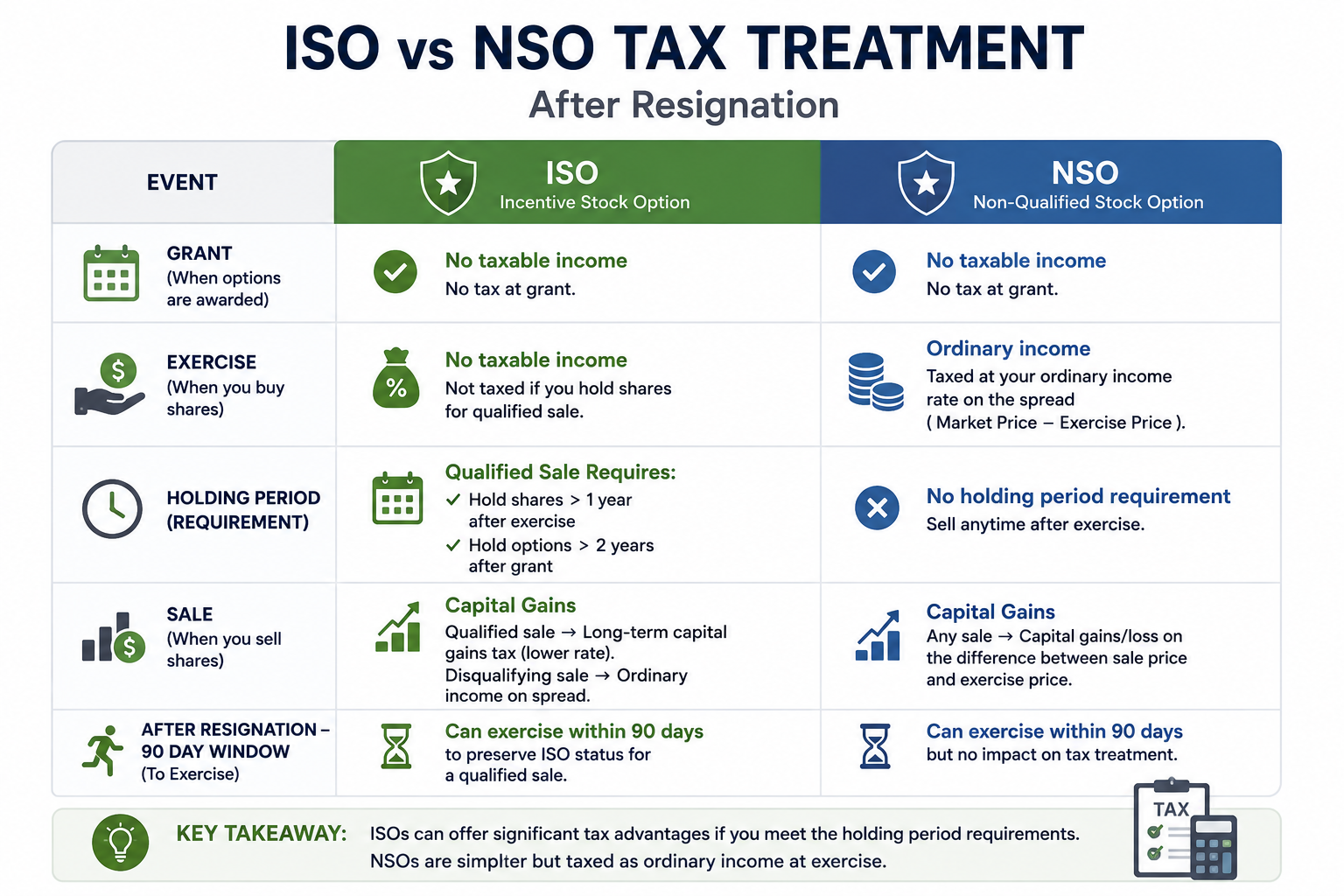
| Feature | Incentive Stock Options (ISOs) | Non-Qualified Stock Options (NSOs) |
|---|---|---|
| Who can receive them | Employees only | Employees, contractors, board members, advisors |
| Tax at exercise | No federal ordinary income tax, but AMT may apply | Ordinary income tax on the spread, reported on your W-2 |
| Exercise deadline to keep favorable tax status | Must exercise within 90 days of departure under IRS rules, or the options convert to NSOs | Set by the company’s plan document, commonly 90 days but negotiable |
| Long-term capital gains eligibility | Possible if held 1 year past exercise and 2 years past grant | Only on gains after exercise, since the spread is already taxed as income |
Here’s the part that trips people up: even if your company grants you a longer PTEP as a courtesy, federal tax law still caps the ISO clock at 90 days after your termination date. Exercise on day 91 or later and the IRS treats those shares as NSOs for tax purposes, no matter what your grant agreement says about the exercise window itself.
How Your Reason for Leaving Changes the Outcome
Plan documents frequently spell out different outcomes depending on why you’re leaving. This is one of the most overlooked details in the whole process.
| Situation | Typical treatment of vested options | Typical treatment of unvested options |
|---|---|---|
| You quit voluntarily | Standard PTEP applies, usually 90 days | Forfeited immediately |
| Laid off (not for cause) | Standard PTEP usually still applies; some severance agreements extend it | Forfeited, unless severance includes acceleration |
| Terminated for cause | May be shortened or eliminated entirely; check your plan’s “cause” definition | Forfeited |
| Retirement | Some plans grant longer windows or partial acceleration for qualifying retirement | Sometimes partially accelerated, depending on age and tenure requirements |
| Death or disability | Plans often extend the exercise window substantially | Sometimes accelerated |
None of these outcomes are guaranteed. They’re set by your specific plan document and grant agreement, and they vary widely between companies. Treat this table as a starting point for questions to ask HR, not a rule that applies everywhere.
What About RSUs and ESPP Shares?
Restricted stock units work differently from options because there’s no purchase decision involved. Unvested RSUs are simply forfeited when you leave, the same as unvested options. Vested RSUs that have already settled into shares are yours outright, no exercise window required, since you already own the stock rather than the right to buy it.
Private companies commonly use double-trigger RSUs, which require both a time-based vesting condition and a liquidity event, such as an IPO or acquisition, before shares actually settle. If you leave before that second trigger occurs, RSUs that appear “vested” on paper may still deliver nothing, because the second condition was never met. Check your grant agreement for this specific structure before assuming vested RSUs are guaranteed.
Employee stock purchase plans (ESPPs) work on a different clock entirely. Most ESPPs require active employment through the purchase date within each offering period. Leave mid-period and you typically forfeit that period’s contribution rights, though your accumulated payroll deductions are usually refunded rather than kept by the company. Shares you already purchased in prior periods are yours to keep and sell, subject to the plan’s own holding period rules for favorable tax treatment.
Tax Implications of Exercising Stock Options After You Leave
Taxes are where a lot of the real cost hides, and the rules differ by option type.
NSOs
When you exercise NSOs, the spread between your strike price and the fair market value is taxed as ordinary income in the year you exercise. Your former employer typically reports this on a W-2, and federal, and often state, income tax withholding applies at exercise.
ISOs
Exercising ISOs doesn’t trigger ordinary income tax, but if you hold the shares past year-end, the spread can count toward the alternative minimum tax (AMT), a parallel tax calculation that can produce a real bill even though no cash changed hands. Your company will send you IRS Form 3921 after an ISO exercise, which documents the exercise price and fair market value you’ll need for your tax return and for figuring your AMT adjustment.
If you meet both holding periods, at least one year after exercise and two years after the original grant date, any gain when you eventually sell qualifies for long-term capital gains treatment. Sell earlier and part or all of the gain gets reclassified as ordinary income instead.
ESPP Shares
ESPP purchases generate IRS Form 3922, which tracks your cost basis and purchase date for future reporting. Selling too soon after purchase, before meeting the plan’s qualifying holding period, generally means the discount is taxed as ordinary income rather than at capital gains rates.
Note: Federal rules set the framework, but state income tax treatment varies. Some states tax the spread the same way as ordinary wages, others have no state income tax at all, and a few have unique rules for equity compensation earned while working in that state. Check your specific state’s guidance or work with a tax professional familiar with equity comp before you file.
Private Company vs. Public Company Considerations
If your former employer is publicly traded, exercising is usually straightforward: you pay the strike price, receive shares, and can sell on the open market whenever you choose, subject to any blackout periods or insider trading restrictions still in effect.
Private company shares are a different story. There’s no public market, so even after exercising, you may not be able to convert those shares to cash until an acquisition or IPO occurs, which could be years away or may never happen. You’ll still owe the exercise cost and, for NSOs, the associated tax bill immediately, even though the shares themselves remain illiquid. Some private companies also include a right of first refusal or company repurchase right in the plan documents, meaning the company can buy back your shares under specific terms even after you’ve exercised.
Before exercising private company options after resignation, ask directly whether the company permits secondary sales, whether there’s a realistic timeline to a liquidity event, and whether a clawback or repurchase provision applies to you.
Steps to Take Before You Give Notice
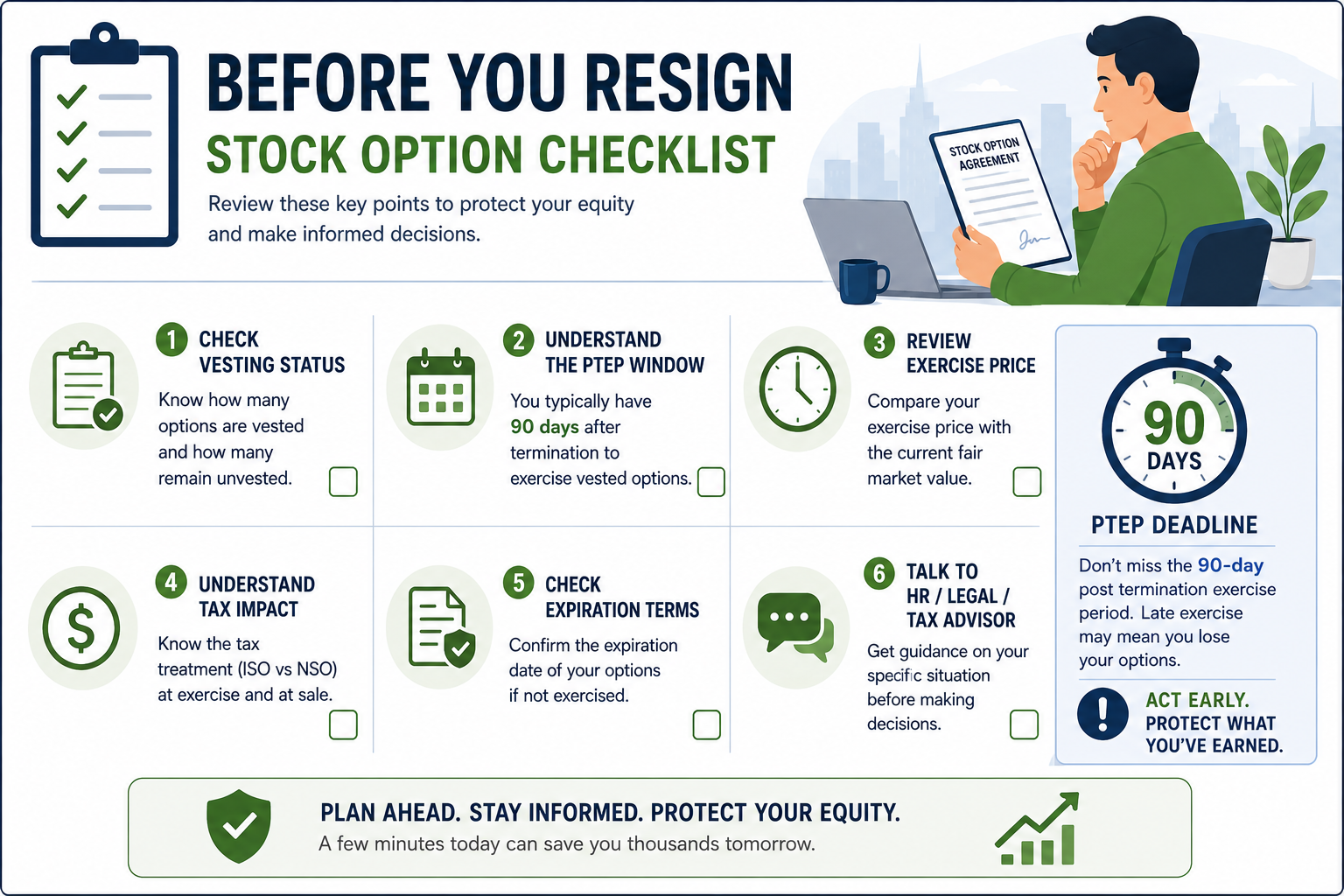
- Pull your grant agreement and plan document. Don’t rely on memory or an old offer letter summary. Get the actual current terms.
- Confirm your exact vesting date and vested share count. Log into your equity platform or ask HR directly.
- Identify your PTEP length in writing. Ask what triggers the clock and get the specific calendar deadline.
- Calculate the full cost to exercise, including the strike price and an estimate of taxes, using a RSU tax calculator or options calculator to model different scenarios.
- Talk to a tax advisor about AMT exposure if you hold ISOs, especially if exercising would push you into a higher tax bracket for the year.
Common Mistakes to Avoid
- Assuming you automatically get 90 days. Some plans set shorter windows. Confirm the actual number in your documents.
- Waiting until after you’ve left to check the details. Once you’re gone, getting timely answers from HR gets harder, and the clock is already running.
- Exercising without a tax plan. An ISO exercise with no AMT planning can create a surprise tax bill with no cash sale to cover it.
- Quitting right before a vesting cliff or vesting date. Leaving a few weeks early can cost an entire year of vested shares.
- Ignoring clawback or repurchase language. Some agreements let the company buy back exercised shares under certain conditions, even ones you’ve already paid for.
- Forgetting ESPP contributions mid-period. Confirm whether your payroll deductions get refunded or forfeited if you leave before the purchase date.
Key Takeaways
- Vested stock options after leaving a company are usually yours to keep, but only if you exercise before the PTEP deadline expires.
- Unvested stock options are almost always forfeited when employment ends, with rare exceptions for accelerated vesting clauses.
- The standard exercise window is 90 days, though it can range from 30 days to several years depending on the plan.
- ISOs lose their favorable federal tax status if exercised more than 90 days after termination, converting to NSOs.
- Your reason for leaving, quitting, layoff, termination for cause, or retirement, can change your exercise rights.
- RSUs and ESPP shares follow different rules than options and deserve separate attention in your grant documents.
- Private company equity carries extra liquidity risk even after a successful exercise.
- Reviewing your plan documents before you give notice, not after, is the single most protective step you can take.
Frequently Asked Questions
What happens to stock options when you leave a company?
You typically keep vested options but must exercise them within a set post termination exercise period, often 90 days. Unvested options are generally forfeited.
Do I lose my stock options if I quit?
You lose any unvested options. Vested options remain exercisable within your plan’s PTEP, provided you complete the exercise and payment before that window closes.
How long do you have to exercise stock options after leaving?
Most plans give 90 days, though some allow 30 days and others extend much further. ISOs are capped at 90 days for tax purposes regardless of what your plan allows.
What happens to unvested stock options when you leave?
They’re typically forfeited immediately, since vesting exists specifically to reward continued employment. Executive agreements occasionally include acceleration clauses that are exceptions to this rule.
What happens to startup stock options when you leave?
The same vesting and PTEP rules apply, but private company shares add liquidity risk since there’s usually no market to sell them until an acquisition or IPO.
Do stock options expire after leaving a company?
Yes, if you don’t exercise within the PTEP. The grant’s original long-term expiration date generally no longer applies once you’re no longer employed.
What happens to ISOs when you leave a company?
You have 90 days to exercise while keeping ISO tax status. After that, any exercise is treated as an NSO for federal tax purposes.
What happens to NSOs when you leave a company?
The exercise window is set by your company’s plan document, commonly 90 days. Exercising triggers ordinary income tax on the spread, generally reported on a W-2.
Can I keep my stock options after leaving?
Vested options stay usable within the PTEP. Unvested options are not something you can keep, since vesting stops the moment employment ends.
What happens to my equity if I’m laid off versus fired for cause?
Layoffs usually preserve your standard PTEP for vested options. Termination for cause can shorten or eliminate the exercise window entirely, depending on how your plan defines “cause.”
Should I exercise my stock options before leaving?
It depends on the cost to exercise, your tax situation, and how confident you are in the company’s future value. There’s no universal answer, and this is a good question to bring to a tax advisor before your last day.
What happens to my stock options if the company gets acquired after I’ve already left?
If you no longer hold unexercised vested options because your PTEP already expired, an acquisition typically has no effect on you. If you exercised and hold shares, treatment depends on the acquisition terms for existing shareholders.
Conclusion
So, what happens to stock options when you leave a company? In short, vested options usually remain yours for a limited window, unvested options are typically forfeited, and the exact outcome depends on your plan document, your option type, and the reason you’re leaving. The details matter more than the general rule, and they’re worth confirming in writing before you resign, not after.
If you’re weighing a departure date or trying to figure out whether exercising makes financial sense, run your numbers through our Share Incentive Plans Calculator or the Employee Stock Option Calculator before you make a final decision.
References
- IRS, Topic No. 427, Stock Options: https://www.irs.gov/taxtopics/tc427
- IRS, About Form 3921, Exercise of an Incentive Stock Option: https://www.irs.gov/forms-pubs/about-form-3921
- IRS, About Form 3922, Transfer of Stock Acquired Through an Employee Stock Purchase Plan: https://www.irs.gov/forms-pubs/about-form-3922
- IRS, Topic No. 409, Capital Gains and Losses: https://www.irs.gov/taxtopics/tc409
This article is for educational purposes only and does not constitute financial, tax, or legal advice. Consult a qualified tax advisor or attorney about your specific equity compensation and employment situation.