
If your offer letter mentions “options” and you nodded along without really knowing what that meant, you’re not alone. Employee stock options are one of the most misunderstood parts of a compensation package, and yet they can end up being worth more than your salary if the company does well.
This guide walks through what employee stock options actually are, how they fit into a broader equity compensation package, the difference between incentive stock options (ISOs) and non-qualified stock options (NSOs), how vesting schedules work, and what you can expect at tax time. By the end, you should be able to look at your own grant and understand roughly what it’s worth and what it will cost you.
If you want to run your own numbers, the Share Incentive Plan Calculator can help you estimate the value of a grant before you make any decisions.
Table of Contents
- What Are Employee Stock Options?
- How Employee Stock Options Fit Into Equity Compensation
- Grant Date vs. Vesting Date
- Understanding the Strike Price (Exercise Price)
- Types of Employee Stock Options: ISOs vs. NSOs
- How Stock Option Vesting Works
- How to Exercise Stock Options
- Tax on Employee Stock Options
- Stock Options vs. RSUs
- What Happens When You Leave the Company
- A Simple Example
- Key Takeaways
- FAQs
- Conclusion
What Are Employee Stock Options?
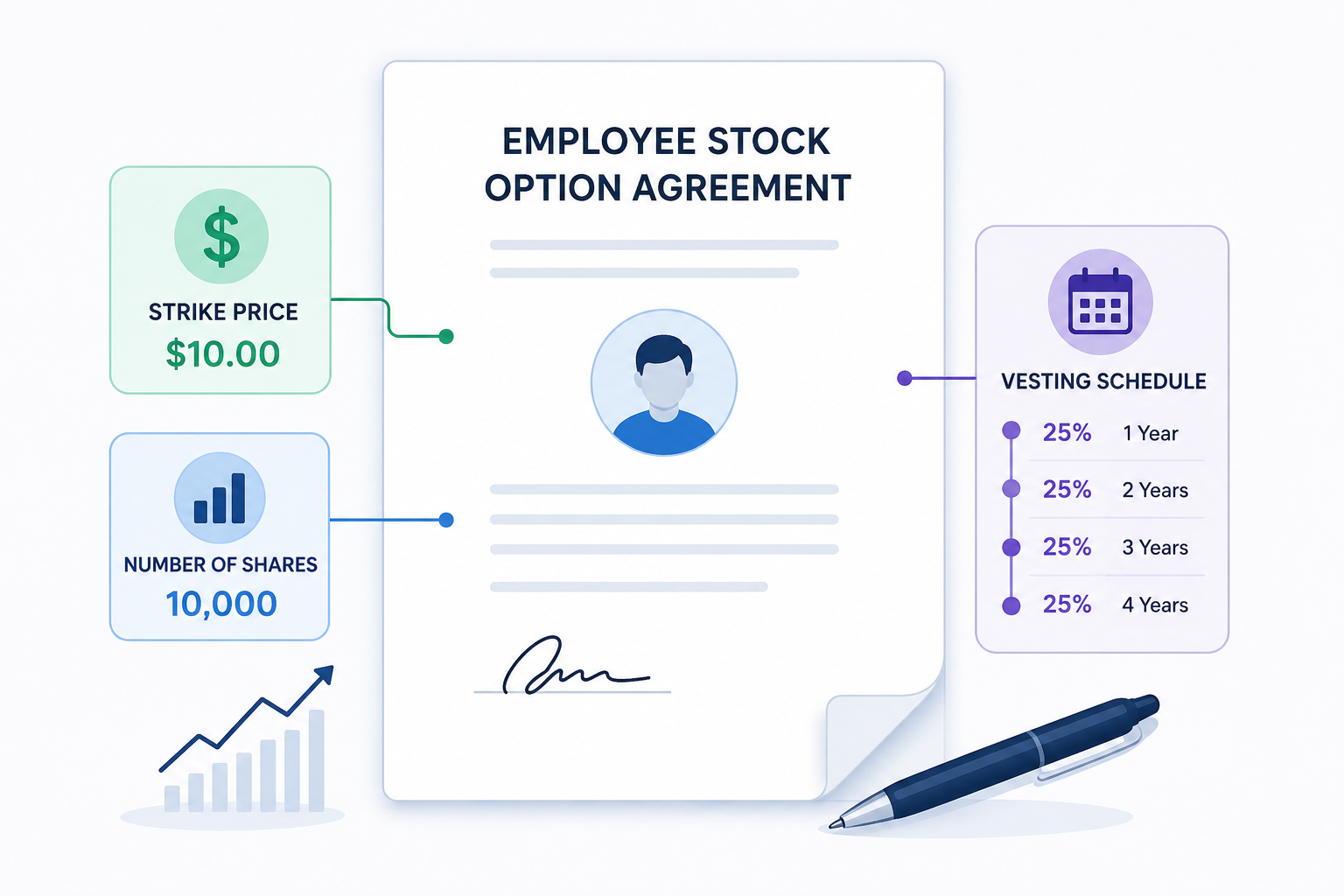
Employee stock options are a form of equity compensation. They give you the right, but not the obligation, to buy a set number of company shares at a fixed price sometime in the future. That fixed price is called the strike price or exercise price.
An option is not the same thing as a share of stock. It’s a contract. You’re not an owner of the company the day you receive an option grant. You become one only if and when you exercise the option by actually buying the shares.
Companies, especially startups, offer employee stock options as part of a compensation package for a simple reason: they often can’t match the cash salaries of larger, established companies. Options let a company offer employees a stake in future growth instead of (or on top of) a bigger paycheck today. This is the basic idea behind an employee stock option plan (ESOP), a program a company sets up to grant options to some or all of its workforce.
How Employee Stock Options Fit Into Equity Compensation
Equity compensation is the broader category that stock options belong to. It includes several different tools companies use to give employees a financial stake in the business:
- Stock options (ISOs and NSOs), the right to buy shares later at today’s price
- Restricted stock units (RSUs), a promise of actual shares once they vest
- Employee stock purchase plans (ESPPs), which let employees buy shares, often at a discount, through payroll deductions
- Restricted stock awards (RSAs), actual shares granted upfront but subject to vesting and forfeiture
Startups and pre-IPO companies tend to lean on stock options because the shares are cheap early on, which means a lower strike price and more room for the value to grow. Public companies and larger private companies often shift toward RSUs or ESPPs because their share price is already established and less volatile.
Understanding where stock options sit in this bigger picture helps you evaluate a job offer or a total compensation package more realistically, rather than looking at just your base salary.
Grant Date vs. Vesting Date
Two dates matter more than any others in your option agreement.
Grant date is the day your company’s board approves and issues your stock option grant. This date sets your strike price and starts the clock on some tax rules, especially for ISOs.
Vesting date (or vesting dates, since most grants vest in stages) is when you actually earn the right to exercise a portion of your options. Until an option vests, you can’t buy those shares even if you wanted to.
It’s easy to confuse these two dates because both appear on your grant paperwork. A simple way to remember it: the grant date is when the company gives you the option, and the vesting date is when that option becomes usable.
Understanding the Strike Price (Exercise Price)
The strike price is the fixed amount you’ll pay per share when you exercise your options. It’s set on the grant date and doesn’t change, no matter what happens to the company’s value afterward.
For private companies, the IRS generally requires the strike price to be set at or above the stock’s fair market value (FMV) on the grant date. Companies typically determine this FMV through an independent appraisal, often referred to as a 409A valuation. Setting the strike price below FMV can create unwanted tax consequences for both the company and the employee, so most companies are careful to follow this rule.
Here’s why the strike price matters so much: your potential profit is the difference between the stock’s value when you sell (or exercise) and your strike price. A lower strike price generally means more room for gains if the company’s value increases. If the current stock price falls below your strike price, your options are “underwater,” meaning exercising them would cost you more than the shares are currently worth.
Types of Employee Stock Options: ISOs vs. NSOs
There are two main categories of employee stock options, and the difference between them mostly comes down to tax treatment.
Incentive Stock Options (ISOs)
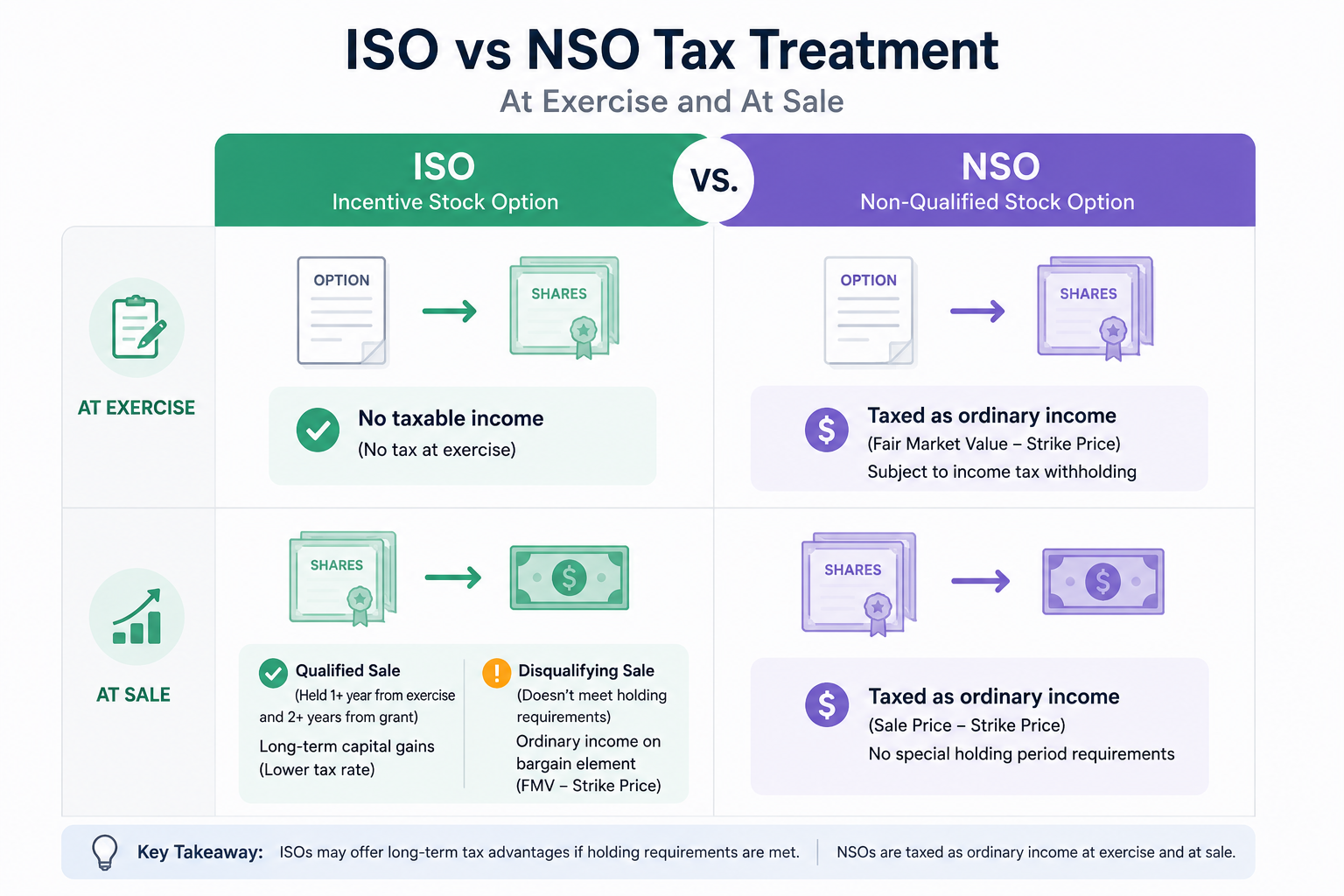
ISOs can only be granted to employees (not contractors or outside advisors) and may qualify for preferential tax treatment under the Internal Revenue Code. If you meet certain holding period requirements, the gain when you eventually sell the shares may be taxed at long-term capital gains rates instead of ordinary income rates.
There’s a tradeoff, though: exercising ISOs can trigger the alternative minimum tax (AMT), a separate tax calculation that sometimes results in a larger bill than you’d expect, even if you haven’t sold any shares yet.
Non-Qualified Stock Options (NSOs)
NSOs can be granted to employees, contractors, board members, and advisors. They don’t come with the same potential tax advantages as ISOs. When you exercise NSOs, the difference between the stock’s FMV and your strike price is generally taxed as ordinary income right away, and it typically shows up on your W-2 if you’re an employee.
Comparison Table
| Feature | ISOs | NSOs |
|---|---|---|
| Who can receive them | Employees only | Employees, contractors, advisors, board members |
| Tax at exercise | Usually no ordinary income tax, but may trigger AMT | Taxed as ordinary income on the spread |
| Tax at sale | May qualify for long-term capital gains rates if holding requirements are met | Any further gain taxed as capital gain (short or long-term) |
| Reported on | Form 3921 (at exercise) | W-2 (at exercise), 1099-B possible at sale |
| Common $100,000 rule | Yes, ISOs exercisable in a calendar year are capped at $100,000 in value (based on grant-date FMV) before the excess is treated as NSOs | Not applicable |
Whether a specific grant is treated as an ISO or NSO under actual IRS rules depends on your company’s plan documents and your individual situation, so always check your grant agreement and consider talking to a tax professional if anything is unclear.
How Stock Option Vesting Works
Vesting is the schedule that determines when you earn the right to exercise your options. Most companies don’t hand over all your options on day one. Instead, they release them gradually to encourage you to stay and contribute over time.
A common structure is a four-year vesting schedule with a one-year cliff. That means:
- You earn nothing during your first year.
- At the one-year mark, a chunk of your options (often 25%) vests all at once.
- The rest usually vests monthly or quarterly over the remaining three years.
If you leave before hitting the cliff, you typically walk away with no vested options at all. Some companies use different structures, such as straight monthly vesting from day one, or performance-based vesting tied to company or individual milestones instead of just time.
Your vesting schedule is spelled out in your grant agreement, so it’s worth reading closely rather than assuming a “standard” four-year, one-year-cliff structure applies.
How to Exercise Stock Options
Exercising means actually buying the shares at your strike price once they’ve vested. There are a few common ways to do this:
- Cash exercise: You pay the strike price out of pocket for each share, plus any taxes owed.
- Cashless exercise: Often available during a liquidity event, this lets you sell some shares immediately to cover the cost of exercising the rest, so you don’t need cash upfront.
- Early exercise: Some grants allow you to exercise unvested options early, subject to a repurchase right the company holds if you leave before vesting. This can have specific tax implications, including the option to file an 83(b) election with the IRS.
Before exercising, it’s worth estimating both the cost of buying the shares and the potential tax bill, especially with ISOs, since the AMT calculation can catch people off guard. Tools like the Employee Stock Option Calculator can help you model different exercise scenarios before you commit any money.
Tax on Employee Stock Options
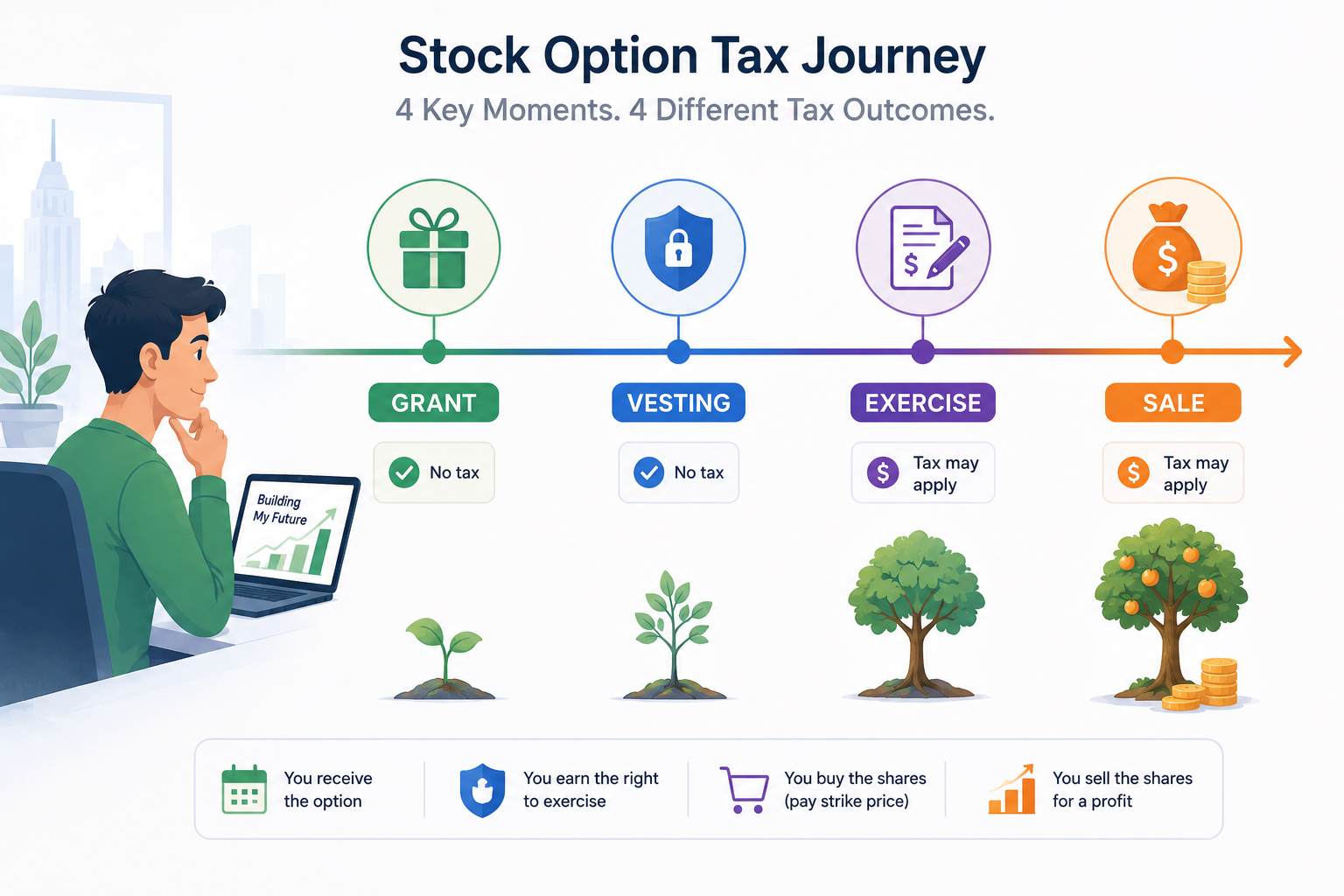
Taxes on stock options depend on the type of option, when you exercise, and when you sell. This is one of the most confusing parts of equity compensation, so it helps to break it down by event.
At exercise:
- NSOs: The spread between FMV and strike price is generally taxed as ordinary income and subject to federal income tax withholding, Social Security, and Medicare taxes.
- ISOs: Usually no regular income tax at exercise, but the spread may count toward AMT income.
At sale:
- If you’ve held ISO shares long enough to meet the qualifying disposition rules (generally more than one year from exercise and two years from grant), gains are typically taxed at long-term capital gains rates.
- If you sell ISO shares before meeting those holding periods (a disqualifying disposition), some or all of the gain may be taxed as ordinary income instead.
- For NSOs, any additional gain above the FMV at exercise is generally taxed as a capital gain, short-term or long-term depending on how long you held the shares after exercising.
Because federal tax rules interact with state tax rules, and because your specific plan documents matter, the numbers above are general concepts rather than your personal tax outcome. State tax treatment of stock options varies, and some states have no state income tax at all, while others tax equity compensation similarly to ordinary wages. It’s worth checking your state’s rules or speaking with a tax professional before making exercise or sale decisions.
Your company should provide relevant tax forms, such as Form 3921 for ISO exercises or a W-2 reflecting NSO income, to help you and the IRS track these events.
Stock Options vs. RSUs
Stock options and restricted stock units (RSUs) are both common forms of equity compensation, but they work differently.
| Feature | Stock Options | RSUs |
|---|---|---|
| What you receive | The right to buy shares at a strike price | An outright promise of shares once vested |
| Cost to acquire | You pay the strike price to exercise | No purchase price, shares are simply delivered |
| Value if stock drops | Can become worthless if stock falls below strike price | Still has some value as long as the stock isn’t worth zero |
| Typical use | Common at startups and early-stage companies | Common at public companies and later-stage private companies |
| Tax timing | At exercise and/or sale, depending on type | Usually at vesting, based on FMV at that time |
Neither is universally “better.” Options offer more upside potential if a low-valued startup grows significantly, since your strike price is locked in early. RSUs offer more certainty, since they retain value even if the stock price doesn’t move much, but they generally offer less leverage in a high-growth scenario.
What Happens When You Leave the Company
When you leave a job, unvested options are typically forfeited and returned to the company’s option pool. You keep the right to exercise whatever has already vested, but only for a limited window of time, often called the post-termination exercise period (PTEP).
This window can be as short as 90 days or considerably longer, depending on your company’s plan. If you don’t exercise within that window, you generally lose the right to purchase those shares permanently. It’s a good idea to check your grant agreement or ask HR about your specific PTEP well before you plan to leave, since this deadline can sneak up on people.
A Simple Example
Say you’re granted options for 1,000 shares with a strike price of $2 per share, vesting over four years with a one-year cliff.
After your first year, 250 shares vest. If the company’s shares are now worth $5 (based on a new valuation), you could exercise those 250 shares for $2 each, paying $500 total, while the shares are worth $1,250. That $750 difference is your paper gain, though what you actually owe in taxes depends on whether these are ISOs or NSOs, and whether you sell right away or hold the shares.
This is a simplified example. Actual outcomes depend on your specific option type, your company’s valuation, applicable federal and state tax rules, and how long you hold the shares before selling.

Key Takeaways
- Employee stock options give you the right, not the obligation, to buy company shares at a fixed strike price.
- ISOs may offer favorable capital gains tax treatment but can trigger the AMT; NSOs are simpler but taxed as ordinary income at exercise.
- Vesting schedules, often four years with a one-year cliff, determine when you can actually use your options.
- The strike price is set at grant and doesn’t change, so a lower strike price generally means more upside potential.
- Stock options and RSUs are both forms of equity compensation, but they work and get taxed differently.
- Leaving your job usually forfeits unvested options and starts a countdown on your window to exercise vested ones.
- Federal and state tax rules can both apply, and specific outcomes depend on your plan documents, so check with a tax professional for your situation.
FAQs
What are employee stock options in simple terms?
They’re a contract that lets you buy a set number of company shares at a fixed price in the future, rather than shares you already own.
What is the difference between ISOs and NSOs?
ISOs are only for employees and may qualify for favorable long-term capital gains treatment, though they can trigger the AMT. NSOs can go to employees, contractors, and advisors, and are generally taxed as ordinary income at exercise.
How does a vesting schedule work?
A vesting schedule spreads out when you earn the right to exercise your options, commonly over four years with a one-year cliff before any shares vest.
What is a strike price?
The strike price, or exercise price, is the fixed amount per share you pay when you exercise your options. It’s set on the grant date.
Do I owe taxes just for receiving stock options?
Generally no. Tax events typically happen at exercise and/or sale, not simply when you’re granted the options, though the exact treatment depends on the option type.
What happens to my stock options if I quit?
Unvested options are usually forfeited. Vested options can typically still be exercised, but only within a limited post-termination exercise window specified in your plan.
Are stock options better than RSUs?
Neither is inherently better. Options can offer more upside in an early-stage company with a low strike price, while RSUs tend to hold value more consistently since there’s no purchase price involved.
Can stock options expire?
Yes. Most option grants have an expiration date, often 10 years from the grant date, and a shorter exercise window if you leave the company beforehand.
What is the ISO $100,000 limit?
It’s a rule limiting the value of ISOs (based on grant-date FMV) that can first become exercisable for an employee in a calendar year to $100,000. Amounts above that are generally treated as NSOs.
Do state taxes apply to stock options?
It depends on your state. Some states have no state income tax, while others tax equity compensation income similarly to wages. Check your specific state’s rules.
How do I know if my options are worth exercising?
Compare the current fair market value of the shares to your strike price, and factor in the cost of exercising plus any tax liability, including possible AMT for ISOs.
Should I use a calculator before exercising my options?
It can help. A calculator lets you model different scenarios, including exercise costs and potential tax outcomes, before committing real money. Try the Share Incentive Plan Calculator to run your own numbers.
Conclusion
Employee stock options can be a genuinely valuable part of your compensation package, but only if you understand how they work. The key things to track are your strike price, your vesting schedule, whether you hold ISOs or NSOs, and how each of those affects your tax bill at exercise and at sale. None of this replaces advice from a qualified tax professional who can look at your specific plan documents and personal financial situation, but having a solid grasp of the basics puts you in a much better position to make informed decisions about your equity. If you’re weighing an offer or trying to figure out what your current grant is worth, the Share Incentive Plans Calculator is a good place to start running the numbers.
References
- Internal Revenue Service, “Topic No. 427, Stock Options,” IRS.gov
- Internal Revenue Service, “About Form 3921, Exercise of an Incentive Stock Option Under Section 422(b),” IRS.gov
- Internal Revenue Service, “About Form 3922, Transfer of Stock Acquired Through an Employee Stock Purchase Plan Under Section 423(c),” IRS.gov
- Internal Revenue Service, “Alternative Minimum Tax (AMT),” IRS.gov
- U.S. Securities and Exchange Commission, “Employee Stock Options,” Investor.gov
- Investopedia, “Employee Stock Option (ESO)”
- National Center for Employee Ownership (NCEO), “Stock Options”