
A Share Incentive Plan (SIP) is a UK, HMRC-approved scheme that lets your employer give you company shares tax-free, or let you buy them straight from your paycheck before tax comes out. Shares sit in a trust for up to five years. Hold them the full five years and you owe no income tax or National Insurance on the value your employer gave you. Leave early, and how much tax you pay depends on why you’re leaving and how long the shares were in the trust.
If your employer has just rolled out a SIP and handed you a booklet full of unfamiliar terms, you’re not alone. Most explanations either oversimplify it into “free shares, yay” or bury you in HMRC language. This guide covers the mechanics, the real numbers, what happens if you quit or get fired, how a SIP stacks up against the other UK share schemes, and how it compares to a US ESPP if that’s the frame of reference you’re coming from.
Table of Contents
- What Is a Share Incentive Plan?
- How Does a Share Incentive Plan Work?
- Who Is Eligible to Join?
- The Four Types of SIP Shares, Side by Side
- Worked Example: What a SIP Actually Saves You
- Vesting vs. the SIP Holding Period
- The 5-Year Tax Rule, Explained by Timeline
- What Happens If You Leave Your Job
- Capital Gains Tax When You Eventually Sell
- Risks and Downsides of a Share Incentive Plan
- SIP vs. SAYE vs. EMI vs. CSOP
- How a SIP Compares to a US ESPP
- How to Join a Share Incentive Plan
- Common Mistakes to Avoid
- Expert Tips
- Frequently Asked Questions
- Key Takeaways
What Is a Share Incentive Plan?
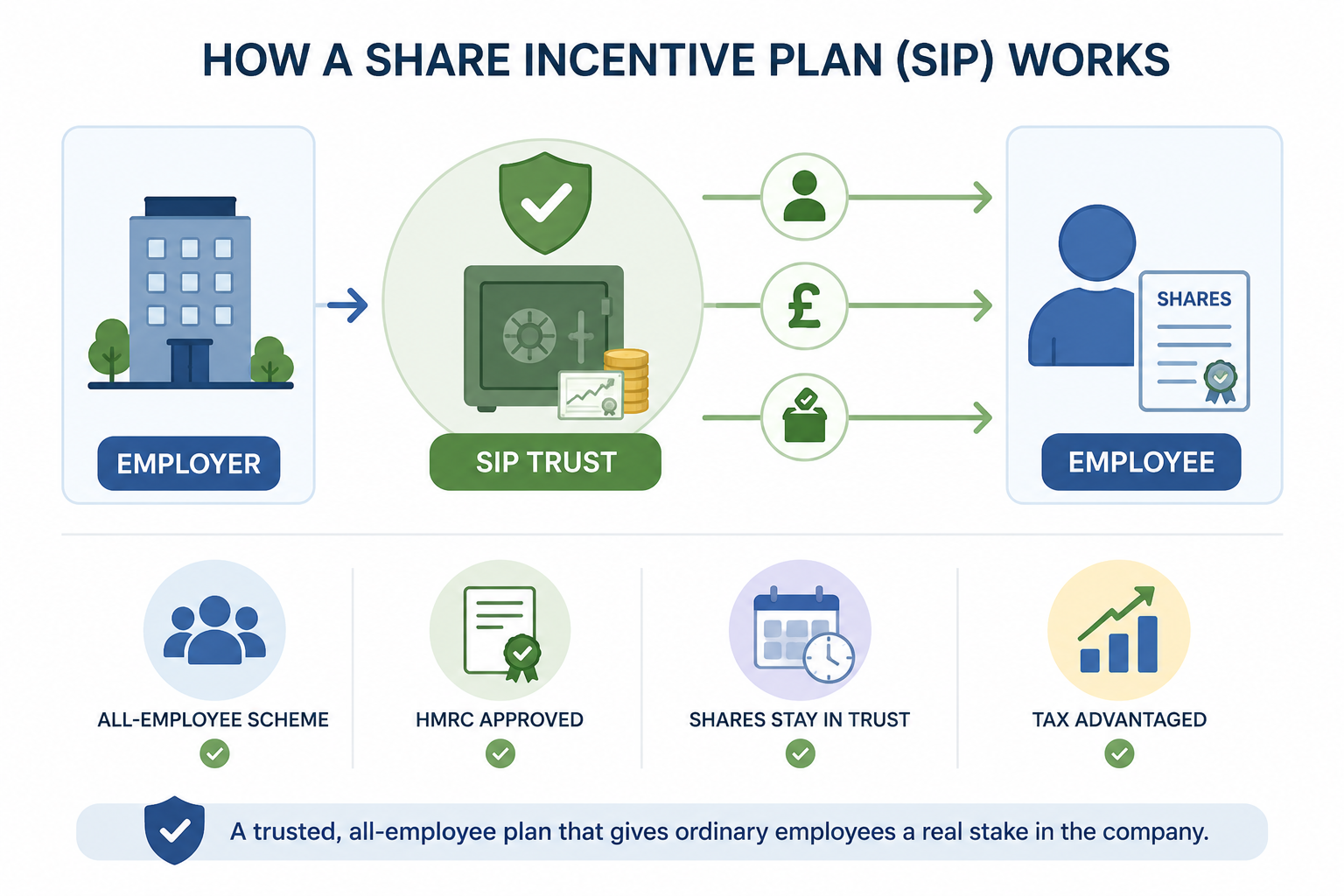
A Share Incentive Plan is one of four tax-advantaged share schemes approved by HMRC in the UK, alongside SAYE, EMI, and CSOP. It was introduced so that ordinary employees, not just executives, could hold a real stake in the company they work for.
The defining feature is the trust. Your employer doesn’t hand you a share certificate directly. Instead, an independent SIP trust, explained in detail in HMRC’s official guide for employees, holds the shares on your behalf. Your name is attached to them, dividends and voting rights generally flow to you, but the shares physically live inside the trust until you remove them, whether by choice or because you’ve left the company. For a closer look at how the trust structure fits into the wider scheme, see our What Is a Share Incentive Plan? guide.
Any employer running a SIP has to offer it to all eligible employees on the same basic terms. A company can’t set up a SIP just for senior staff. That “all-employee” requirement is what qualifies the scheme for its tax breaks in the first place, and it’s set out in ITEPA 2003, Schedule 2 , the legislation that governs approved Share Incentive Plans.
How Does a Share Incentive Plan Work?
Once you’re enrolled, there are four separate ways shares can land in your trust account, and most companies only offer some combination of them rather than all four. If you want to estimate your own numbers as you read, our Share Incentive Plan Calculator can run the math on any contribution and match ratio.
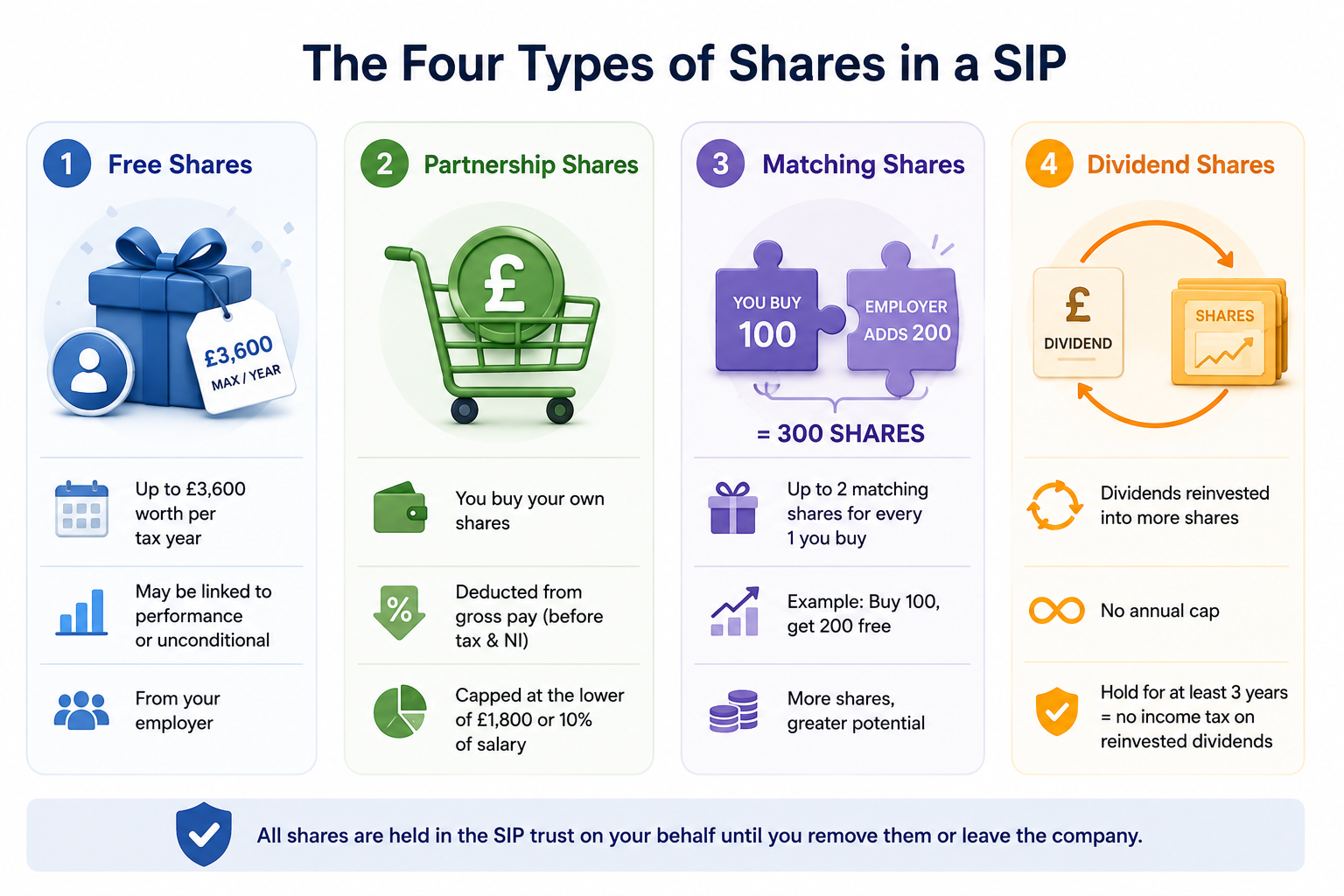
- Free shares — your employer gives you shares at no cost, sometimes tied to performance or company results.
- Partnership shares — you buy shares yourself, straight out of your gross salary, before income tax and National Insurance are deducted.
- Matching shares — for every partnership share you buy, your employer can throw in up to two more, free.
- Dividend shares — instead of paying dividends into your bank account, the trust reinvests them into more shares.
The shares stay inside the trust for a set period, typically structured around a five-year mark, because that’s the point at which the full tax advantage kicks in. Take them out sooner and you may owe tax on some portion of the value, depending on which type of share it is and why you’re removing them.
Who Is Eligible to Join?
Employers can set a waiting period before new hires can join a SIP, but HMRC caps that at 18 months of employment. Beyond that cap, every employee who meets the plan’s basic conditions has to be invited on the same terms. Some companies also include employees of qualifying subsidiaries in a group structure, and part-time or fixed-term staff are generally eligible too, as long as they’re on the payroll.
The Four Types of SIP Shares, Side by Side
Here’s how the four share types compare on cost, annual limits, and how the money moves.
| Share Type | Who Pays | Annual Limit (2026) | Key Detail |
|---|---|---|---|
| Free Shares | Employer | Up to £3,600 | Can be linked to performance targets |
| Partnership Shares | Employee (pre-tax salary) | Lower of £1,800 or 10% of salary | Bought before income tax and NI are deducted |
| Matching Shares | Employer | Up to 2 per partnership share bought | Employer sets the actual ratio, capped at 2:1 |
| Dividend Shares | Reinvested dividends | No fixed annual cap | Tax-free if held 3+ years in the plan |
Figures reflect current published HMRC limits for Share Incentive Plans and should be checked against the latest GOV.UK guidance for the applicable tax year before you rely on them.
Free Shares
Your employer can award up to £3,600 worth of free shares per tax year, running from 6 April to 5 April. Companies often link this to individual, team, or company-wide performance, but it doesn’t have to be conditional.
Partnership Shares
This is the “buy your own” side of the scheme. You agree to a regular deduction from your gross pay, capped at whichever is lower: £1,800 a year, or 10% of your salary. Because the deduction happens before tax, you’re effectively buying shares at a discount equal to your marginal tax and NI rate.
Matching Shares
This is where a SIP gets genuinely generous. For every partnership share you buy, your employer can add up to two matching shares on top, entirely free. Buy 100 partnership shares and a 2:1 match hands you 200 more, for a total of 300 shares from a purchase that only cost you the price of 100.
Dividend Shares
If the shares you hold pay dividends, the trust can reinvest that cash into more shares instead of paying it out to you. There’s no annual cap on dividend shares, and if you leave them in the plan for at least three years, you pay no income tax on that reinvested dividend value.
Worked Example: What a SIP Actually Saves You
Numbers make this concrete. Say you earn £40,000 a year and pay the basic 20% tax rate plus 8% employee National Insurance.
You decide to put £100 a month into partnership shares, £1,200 a year, and your employer matches at a 1:1 ratio.
- Your cost: £1,200 a year, deducted before tax
- Tax and NI you’d normally pay on £1,200 of salary: roughly £336 (28% combined)
- Employer match: £1,200 worth of free matching shares
- Total shares acquired: £2,400 worth, for a real cost to you of £864 after the tax and NI relief
If you hold everything in the trust for the full five years and the share price hasn’t moved, you’ve turned £864 of take-home pay into £2,400 of shares, with no income tax or NI due on any of it. If the share price rises over those five years, that gain is on top, and it’s also outside income tax and NI. This is a simplified illustration; your own numbers will depend on your tax band, employer match ratio, and the plan’s specific rules.
Vesting vs. the SIP Holding Period: They’re Not the Same Thing
If you’ve come across RSUs or stock options before, you’ll have heard the word “vesting,” and it’s tempting to apply it here. A SIP doesn’t really work that way.
With RSUs, unvested shares aren’t yours yet at all; you only own them once a vesting condition (usually time-based) is met, and if you leave beforehand, you typically forfeit them outright. With a SIP, the shares are allocated to you and held in trust from day one. What varies with time isn’t ownership, it’s the tax treatment of removing them. That’s a holding period, not a vesting schedule, and mixing the two up is one of the most common misunderstandings employees have about how a SIP works.
The 5-Year Tax Rule, Explained by Timeline
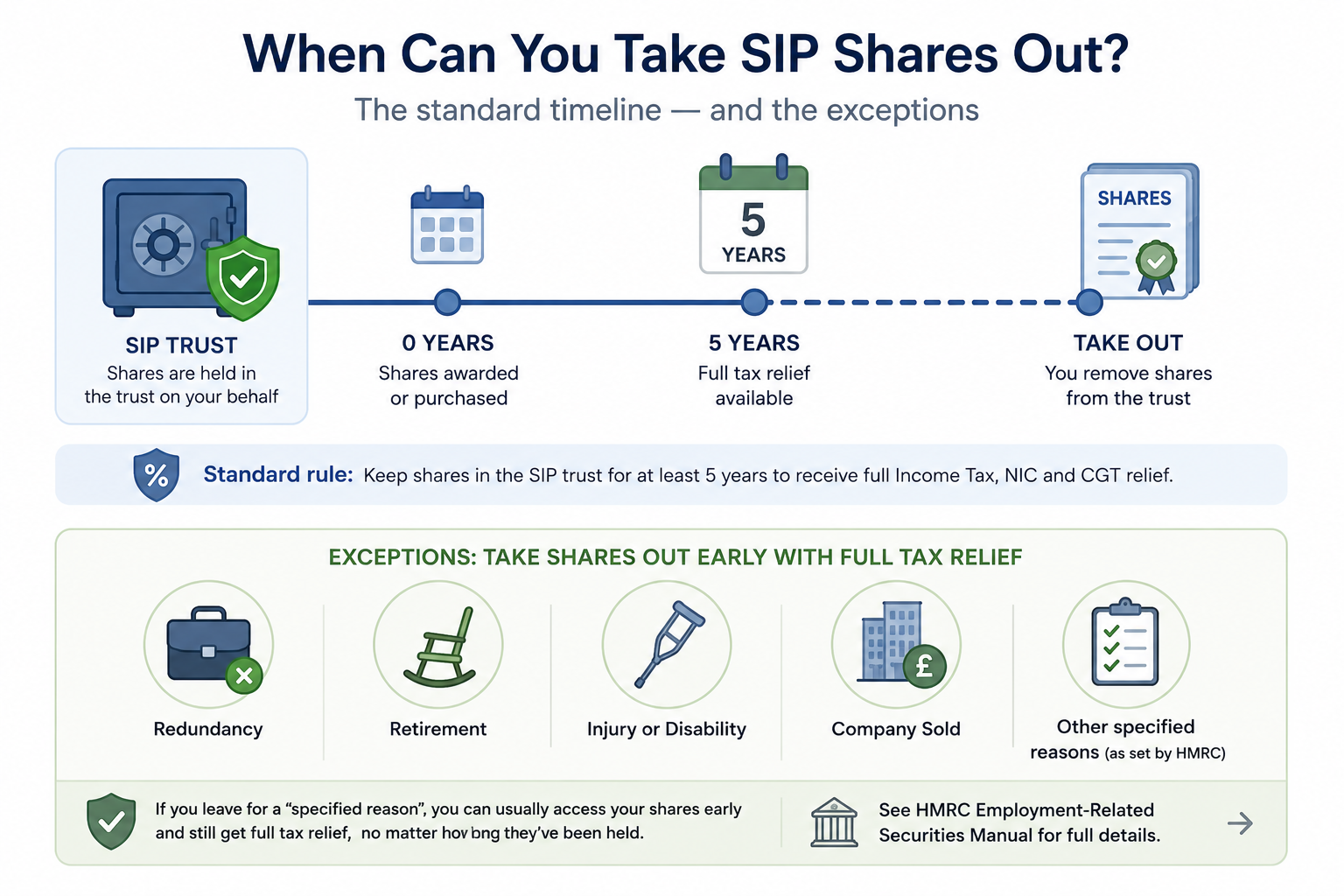
Tax treatment on free, partnership, and matching shares depends on how long they’ve sat in the trust before you take them out.
| Time in Trust | Tax Treatment on Removal |
|---|---|
| Under 3 years | Income tax and NI due on the market value at the date of removal |
| 3 to 5 years | Income tax and NI due on the lower of the value at award and the value at removal |
| 5 years or more | No income tax or NI due on removal |
There are exceptions to this timeline. If you’re leaving for what HMRC treats as a “specified reason”, redundancy, retirement, injury or disability, or the company being sold, you can usually take your shares out early with the full tax relief still applying, regardless of how long they’ve been held. HMRC’s Employment-Related Securities Manual sets out the full list of specified reasons employers must apply.
What Happens If You Leave Your Job
Leaving your employer forces your shares out of the trust, and what happens next depends on which category you fall into.The rules differ across other equity types, if you’re weighing multiple offers.
Specified-Reason Leavers
If you’re leaving because of redundancy, retirement at the plan’s normal retirement age, injury, disability, death, or because the company is being sold or taken over, HMRC generally lets you keep the full tax relief no matter how long the shares have been in the trust.
Any Other Reason for Leaving
If you resign, get dismissed, or leave for a reason that doesn’t qualify as “specified,” the 3-year and 5-year timeline above applies in full. Shares held under three years get taxed on their market value at removal. That can be an unwelcome surprise if you’re job-hopping early in your SIP participation.
Unvested vs. Forfeited: A Note on Free and Matching Shares
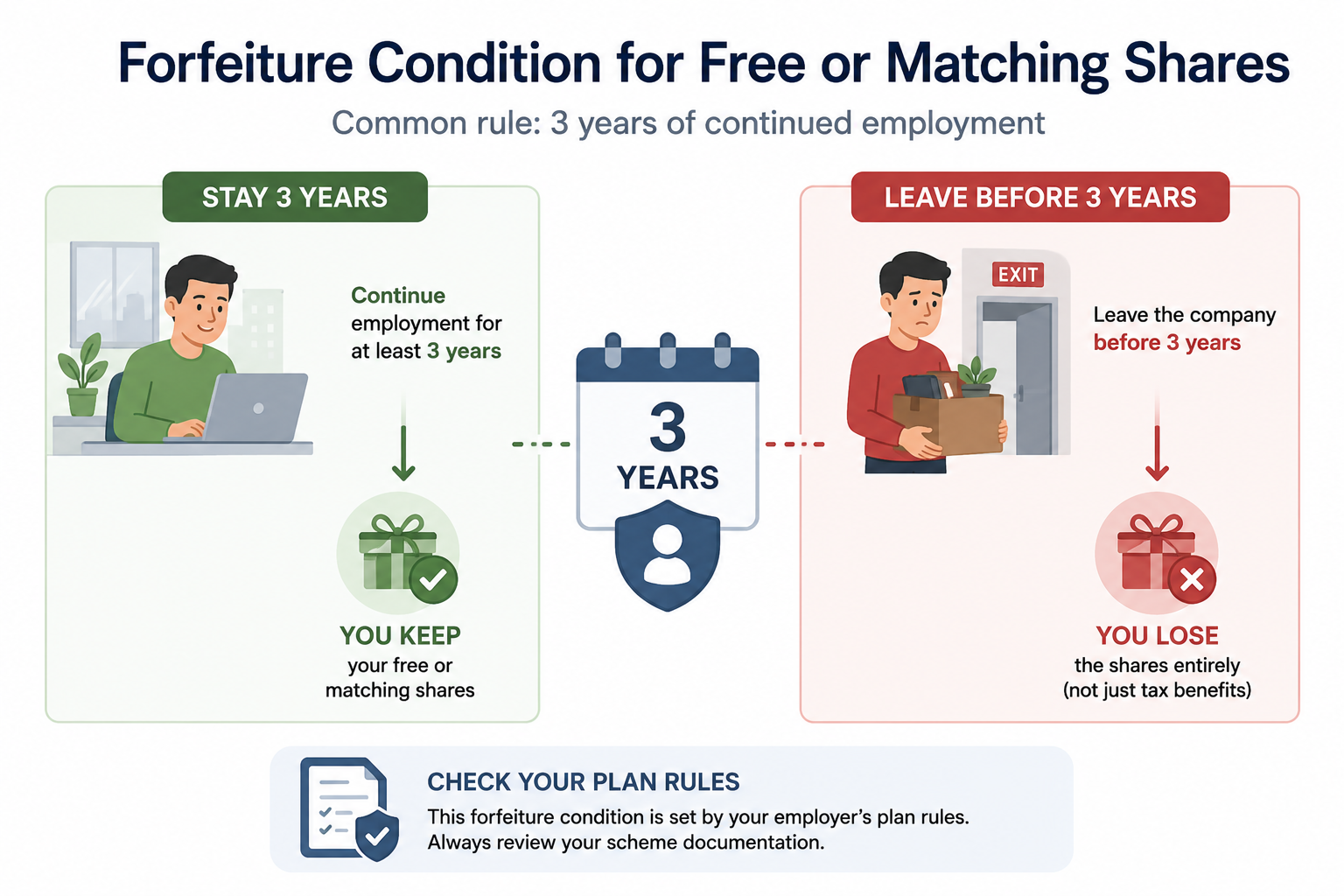
Some plans attach a separate forfeiture condition to free or matching shares, commonly requiring three years of continued employment or you lose the shares entirely, not just the tax benefit. This is set by your specific employer’s plan rules, so check your scheme documentation rather than assuming it works the same way everywhere.
Capital Gains Tax When You Eventually Sell
Selling shares directly out of the SIP trust triggers no Capital Gains Tax, regardless of how much they’ve gained in value. That’s one of the scheme’s biggest and most underrated advantages. GOV.UK’s guidance on tax and employee share schemes covers how this compares to CGT treatment on other equity types.
If instead you transfer the shares out of the trust into your own name and hold onto them, any future growth from that point is subject to normal CGT rules when you eventually sell, measured against your annual CGT allowance and rate band. The market value on the day the shares left the trust becomes your new cost basis for that calculation.
Risks and Downsides of a Share Incentive Plan
A SIP is a genuinely good deal in tax terms, but it isn’t risk-free, and it’s worth being honest about the downsides before you commit a chunk of your salary to it.
- Share price risk: your partnership shares are bought with real money, and if the company’s share price falls, that money can be worth less than you paid, tax break or not.
- Concentration risk: your salary and a chunk of your savings end up tied to the same company. If the business struggles, both your job and your investment take the hit at once.
- Illiquidity: shares sit in the trust and generally can’t be sold on a whim; withdrawing early can also cost you the tax benefit.
- No guaranteed return: free and matching shares are a genuine bonus, but a falling share price can still erode their value while they sit in the trust.
Share Incentive Plan vs. SAYE vs. EMI vs. CSOP
A SIP is one of four HMRC-approved share schemes, and it’s not always the right fit. Here’s how the four compare.
| Scheme | How It Works | Who It’s For | Main Advantage |
|---|---|---|---|
| SIP | Actual shares held in trust; free, partnership, matching, and dividend shares | All eligible employees | Immediate share ownership with tax-free growth after 5 years |
| SAYE (Sharesave) | Save monthly into a savings contract, then use it to buy shares at a fixed, discounted price | All eligible employees | No downside risk on the saved cash; option to walk away and keep the savings |
| EMI | Discretionary share options granted to selected employees | Small and growing companies, key hires | Very favorable CGT treatment; highly flexible for employers |
| CSOP | Discretionary share options up to a set individual limit | Larger companies not eligible for EMI | Tax-advantaged options without an all-employee requirement |
The short version: a SIP gives you real shares now, funded partly by your own salary. SAYE gives you a savings contract with an option to buy later at a locked-in discount, with much less risk to your cash. EMI and CSOP are option schemes typically reserved for specific employees rather than the whole workforce.
How a SIP Compares to a US ESPP
If you’re used to the American equivalent, an Employee Stock Purchase Plan, a SIP will feel familiar in spirit but different in mechanics. Both let you buy company stock through payroll deductions, and both exist to build broad-based employee ownership.
The differences are what matter. An ESPP typically works on offering periods with a purchase price discount, often 15%, applied at either the start or end of the period, whichever is lower. A SIP doesn’t use a purchase discount at all; instead, its advantage comes from the employer’s free and matching shares, plus the income tax and National Insurance relief on shares bought through payroll. An ESPP’s tax treatment runs through the US qualified/disqualifying disposition rules; a SIP runs entirely through the UK’s 5-year holding period rule and HMRC’s specified-leaver exceptions. If you’re relocating between the US and UK, or your employer offers both types of plan in different markets, treat them as related but genuinely separate schemes rather than direct substitutes.
How to Join a Share Incentive Plan
- Confirm your employer actually offers a SIP, usually through HR or your benefits portal.
- Check whether you’ve cleared any waiting period (capped at 18 months by HMRC).
- Review the plan documentation for the specific share types on offer and any matching ratio.
- Decide how much of your salary you’re comfortable committing to partnership shares, if that option is offered.
- Enroll through your employer’s chosen platform and set your contribution level.
- Keep track of your holding period for each batch of shares, since free, matching, and partnership shares awarded at different times each start their own 5-year clock.
Common Mistakes to Avoid
- Assuming it works like RSU vesting. Ownership and tax treatment are separate things in a SIP.
- Withdrawing shares right before hitting the 5-year mark. A few weeks of patience can be the difference between owing tax and owing nothing.
- Over-committing salary to partnership shares. The tax break is real, but so is the concentration risk of holding both your paycheck and your savings in one company.
- Not checking the leaver rules before resigning. Whether your reason for leaving counts as “specified” can significantly change your tax bill.
- Ignoring dividend reinvestment terms. Missing the 3-year mark on dividend shares means paying tax you could have avoided.
Expert Tips
- If your employer offers matching shares, treat that as close to free money and prioritize contributing enough to capture the full match before topping up other savings.
- Track each award’s individual holding-period clock separately. Shares awarded in different months don’t all become tax-free on the same date.
- If you’re planning to leave your job, check whether your reason for leaving qualifies as a specified reason before you hand in notice, timing can matter.
- Talk to a CPA or financial advisor before making a large partnership share commitment, especially if you’re near a tax band threshold.
Frequently Asked Questions
Is a Share Incentive Plan worth it?
For most eligible employees, yes, particularly if your employer offers matching shares. The combination of tax relief and free matched shares is difficult to replicate through ordinary saving or investing. The main caveat is concentration risk: don’t put more into it than you’re comfortable having tied to your employer’s share price.
How much tax do you save on a Share Incentive Plan?
It depends on your tax band and how much your employer matches, but employees commonly avoid income tax and National Insurance, together often around 28-42% depending on your bracket, on the value of shares bought through payroll and on any employer match, provided the shares stay in the trust long enough.
What happens to your shares if you leave your job?
Your shares come out of the trust. If you’re leaving for a specified reason like redundancy or retirement, you generally keep the full tax relief. If you’re leaving for another reason, tax depends on how long the shares were held, following the 3-year and 5-year timeline.
Can I lose my Share Incentive Plan shares?
You can lose value if the share price falls, since partnership shares are bought with real money. Some plans also attach a forfeiture condition to free or matching shares if you leave within a set period, check your specific plan rules.
Is a SIP the same as an ESPP?
No. Both use payroll deductions to buy company stock, but an ESPP relies on a purchase-price discount and US tax rules, while a SIP relies on employer-funded free and matching shares plus UK income tax and NI relief under a 5-year holding rule.
Key Takeaways
- A SIP holds your shares in a trust; you can receive free shares, buy partnership shares from pre-tax pay, get employer matching shares, and reinvest dividends.
- Hold shares for 5 years and their removal is free of income tax and National Insurance.
- Leaving for a specified reason (redundancy, retirement, ill health, company sale) generally preserves full tax relief regardless of holding period.
- Selling directly out of the trust avoids Capital Gains Tax; transferring shares out first exposes future gains to CGT.
- A SIP carries real share price and concentration risk, it isn’t a risk-free benefit.
- A SIP is UK-specific; the closest US equivalent is an ESPP, but the mechanics and tax rules differ substantially.
This article is educational content and does not constitute individualized tax, legal, or financial advice. Share Incentive Plan rules and limits are set by HMRC and can change between tax years. Confirm current thresholds and your personal tax position with a qualified accountant or financial advisor before making decisions about your plan.