
If your offer letter or grant agreement mentions stock options, you’ve probably run into the terms ISO and NSO and wondered what the letters even stand for, let alone what they mean for your tax bill. The short version: ISO stands for incentive stock option, NSO stands for non-qualified stock option, and the ISO vs NSO distinction is almost entirely about taxes. Both give you the right to buy company stock at a fixed price. How much you owe the IRS, and when you owe it, depends heavily on which one you were granted.
This guide walks through exactly how each type works, who can receive them, when taxes hit, and how to think about the decision whether you’re an employee holding options or a founder deciding what to grant.
In this guide, you’ll learn:
- The core legal and tax differences between ISOs and NSOs
- Exactly when each type gets taxed, and at what rate
- How the alternative minimum tax (AMT) applies to ISOs
- What a qualifying versus disqualifying disposition means for your tax bill
- How state taxes and multi-state work can change your numbers
- Common mistakes that turn a good equity grant into a tax headache
Table of Contents
- What Is an ISO?
- What Is an NSO?
- ISO vs NSO: Side-by-Side Comparison
- How ISOs Are Taxed
- How NSOs Are Taxed
- Worked Example: Same Numbers, Two Outcomes
- Federal vs. State Tax Considerations
- Qualifying vs. Disqualifying Dispositions
- What Happens If You Leave the Company
- Common Mistakes to Avoid
- How a Stock Option Calculator Helps
- Key Takeaways
- FAQs
Stock options are one of the more confusing pieces of a compensation package, mostly because the tax rules were written for a fairly narrow set of situations and then applied to every kind of company imaginable. Understanding the ISO vs NSO split is the first real step toward understanding your own equity.
What Is an ISO?
An incentive stock option, or ISO, is a type of employee stock option that the IRS treats as a “statutory” stock option. That label matters because it means ISOs get access to a special set of tax rules that no other equity award qualifies for.
ISOs can only be granted to common-law employees. Contractors, advisors, and non-employee board members are never eligible, no matter how the paperwork is written. If a company issues what it calls an ISO to someone who isn’t an employee, the grant doesn’t actually qualify as an ISO under the tax code, and it gets treated as an NSO instead.
The appeal of an ISO is that, if you follow the rules, you can avoid paying regular income tax at exercise and instead pay long-term capital gains tax when you eventually sell the shares. That’s a meaningfully lower rate for most people. The catch is that qualifying for this treatment requires meeting specific holding periods and limits, which we’ll break down below.
What Is an NSO?
A non-qualified stock option, or NSO (sometimes written NQSO), is the more flexible but less tax-advantaged sibling of the ISO. The IRS calls these “nonstatutory” stock options because they don’t meet the requirements for special tax treatment.
NSOs can be granted to anyone providing services to the company: employees, independent contractors, consultants, and non-employee directors. That flexibility is exactly why companies use NSOs for advisors and contractors, and why any ISO grant that exceeds the $100,000 annual limit automatically becomes an NSO for the excess amount.
The tradeoff for that flexibility is that NSOs create a straightforward, immediate taxable event when they’re exercised. There’s no waiting for a sale to trigger income tax the way there sometimes is with ISOs.
ISO vs NSO: Side-by-Side Comparison
| Feature | ISO | NSO |
|---|---|---|
| Who can receive them | Employees only | Employees, contractors, advisors, directors |
| Tax at grant | None | None |
| Tax at vesting | None (assuming exercise price = FMV at grant) | None (assuming exercise price = FMV at grant) |
| Tax at exercise | Generally no regular income tax, but the spread is an AMT preference item | Ordinary income tax and payroll tax on the spread |
| Tax at sale | Long-term capital gains if holding periods are met (qualifying disposition); otherwise partly ordinary income | Capital gains on any appreciation after exercise |
| Annual value limit | $100,000 (based on grant-date FMV) becoming exercisable per year | No limit |
| Post-termination exercise window | Typically 3 months (longer for death or disability) | Set by the plan, often longer than 3 months |
| Company tax deduction | None | Deduction equal to employee’s ordinary income at exercise |
| Maximum term | 10 years (5 years for greater-than-10% owners) | Usually set at 10 years by the plan, no statutory cap |
Note: This table reflects federal tax treatment. State rules, especially around AMT, can differ. See the Federal vs. State Tax Considerations section below.
If you’re weighing ISOs against other equity types entirely, our Employee Stock Option Calculator can help you model exercise costs and potential gains before you commit.
How ISOs Are Taxed
The ISO tax story happens in two possible stages: exercise and sale.
At exercise: In most cases, exercising an ISO does not create regular federal income tax. This is the headline benefit of ISOs. However, the spread between your exercise price and the stock’s fair market value on the exercise date is added back as income for AMT purposes, even though you haven’t sold anything and haven’t received any cash. If your AMT liability, calculated with that addback, ends up higher than your regular tax liability, you pay the difference. This is the part of ISO taxation that catches people off guard, especially at companies whose valuation has grown a lot since the option was granted.
At sale: What happens next depends on how long you’ve held the shares. If you meet both ISO holding period requirements, described in a later section, your entire gain is taxed as long-term capital gains. If you sell too early, part of the gain gets reclassified and taxed at ordinary income rates instead.
Your company reports ISO exercises to you and the IRS on Form 3921, which shows the grant date, exercise date, exercise price, and FMV at exercise. Keep this form. You’ll need the numbers on it to calculate your AMT adjustment and, later, your cost basis for the sale.

How NSOs Are Taxed
NSO taxation is more predictable, if less favorable.
At exercise: The spread between your exercise price and the current FMV is taxed as ordinary income in the year you exercise. Because this is treated like wages, your employer generally withholds federal income tax, Social Security, and Medicare on that amount, along with any applicable state withholding. This income shows up on your W-2 for the year, similar to how RSU income is reported.
At sale: Once you’ve exercised and own the shares outright, any further appreciation is taxed as a capital gain. If you sell within a year of exercising, that gain is short-term and taxed at ordinary rates. If you hold for more than a year past exercise, it qualifies for long-term capital gains treatment.
Because NSOs generate a tax bill at exercise regardless of whether you sell any shares, many people choose a cashless or same-day-sale exercise, selling enough shares immediately to cover the tax withholding.
Worked Example: Same Numbers, Two Outcomes
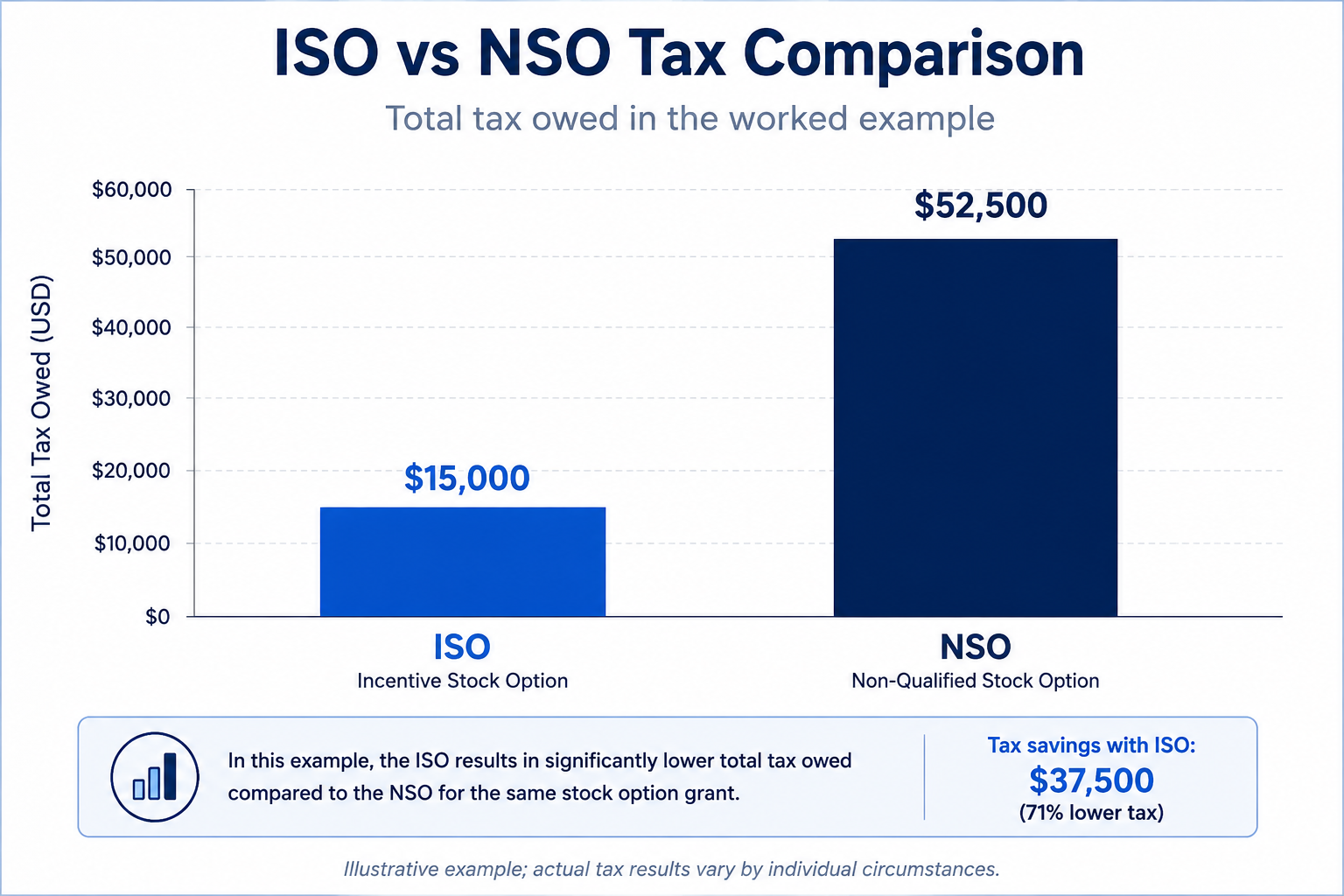
Numbers make the ISO vs NSO gap easier to see than definitions alone. Say an employee is granted options on 1,000 shares with a $2 exercise price. By the time the options vest and the employee exercises, the stock is worth $10 per share. The employee holds the shares for more than a year after exercise and more than two years after grant before selling at $20 per share.
| Step | ISO | NSO |
|---|---|---|
| Exercise price paid | $2,000 (1,000 x $2) | $2,000 (1,000 x $2) |
| Spread at exercise ($10 – $2 = $8/share) | $8,000, not regular income, but an AMT addback | $8,000, taxed as ordinary income at exercise |
| Tax at exercise | Possible AMT liability on the $8,000 spread | Ordinary income tax (plus payroll tax) on $8,000 |
| Sale price | $20,000 (1,000 x $20) | $20,000 (1,000 x $20) |
| Gain taxed at sale | $18,000 taxed as long-term capital gains (assuming qualifying disposition) | $10,000 taxed as long-term capital gains ($20 sale minus $10 FMV at exercise) |
The ISO holder defers more of the gain into the lower long-term capital gains bracket, assuming the holding periods are met and AMT doesn’t create an outsized bill along the way. The NSO holder pays ordinary income tax up front on a bigger chunk of the total gain, but faces less uncertainty and no AMT exposure.
Federal vs. State Tax Considerations
Everything above describes federal tax treatment. Your actual bill also depends on where you live and work, and state rules don’t always mirror the federal ones.
Some states impose their own AMT calculation on top of the federal one, which can mean an additional state-level AMT bill when you exercise ISOs, separate from and calculated differently than the federal AMT. Other states have no personal income tax at all, which removes an entire layer of exposure on both ISO and NSO income.
Important: If you work remotely across state lines, or you moved during the vesting period, sourcing rules can allocate part of your equity income to more than one state. This is a common surprise for remote employees and one worth reviewing with a tax professional before you exercise or sell.
Because state treatment varies so much and changes over time, this article won’t state specific state tax rates or thresholds. Check your state’s department of revenue or work with a CPA licensed in your state for the exact numbers that apply to you.
Qualifying vs. Disqualifying Dispositions
This distinction only applies to ISOs, and it determines whether you actually get the favorable tax treatment ISOs are known for.
A qualifying disposition happens when you sell ISO shares after holding them for at least two years from the grant date and at least one year from the exercise date. Meet both conditions, and your entire gain from exercise price to sale price is taxed as long-term capital gains.
A disqualifying disposition happens when you sell before meeting either of those two holding periods. In that case, the spread at exercise is generally taxed as ordinary income (similar to how an NSO would be taxed), and only the additional gain from exercise-date value to sale price gets capital gains treatment.
This is one of the most common ways people accidentally lose the ISO tax benefit. Selling shares too early, even by a few weeks, can convert what would have been a fully capital-gains sale into a partly ordinary-income one.
What Happens If You Leave the Company
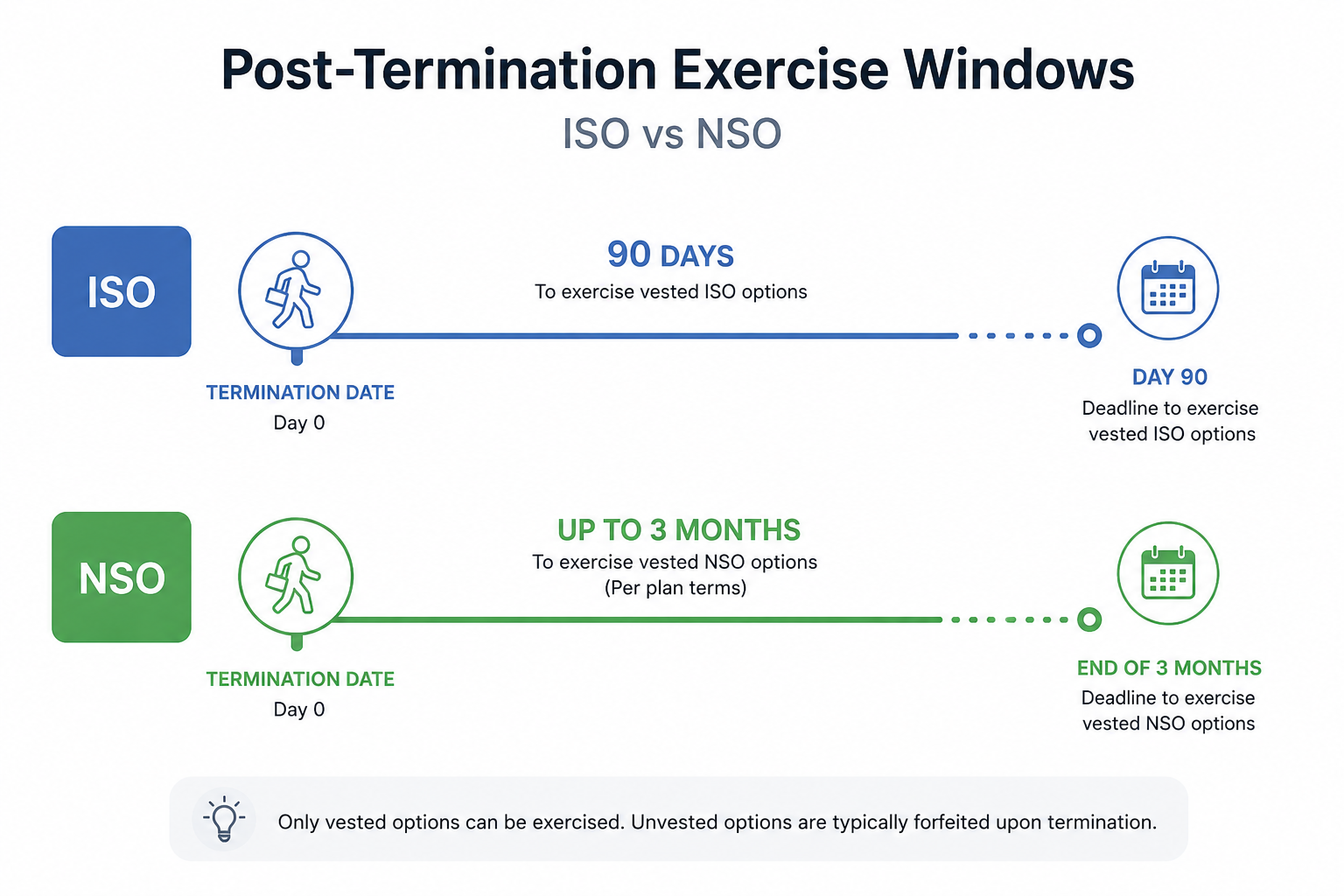
Both option types come with a deadline for exercising after you leave. For ISOs, you typically have three months to exercise vested options before they’re forfeited, though longer windows apply in cases of death or disability, and the plan itself might set a different timeframe. Miss that window and the ISO treatment is off the table entirely, whether or not the plan extends the exercise period.
NSOs are governed entirely by the plan document, which may allow a longer post-termination exercise period, sometimes years. It’s worth checking, because a growing number of companies have extended NSO exercise windows well beyond the traditional 90 days specifically to reduce the pressure employees feel to exercise (and pay taxes) immediately after leaving.
If a company is acquired while you hold unexercised options, the acquisition agreement typically spells out whether your options get cashed out, converted into acquirer stock, or accelerated. If you’re already holding exercised shares that haven’t met the ISO holding period yet, an acquisition can force an earlier sale than you planned, which may turn what would have been a qualifying disposition into a disqualifying one.
Common Mistakes to Avoid
- Exercising ISOs without checking AMT exposure first. A large spread can create a real tax bill even though no regular income tax is due. Run the numbers before you exercise, not after.
- Selling ISO shares too early. Even missing the holding period by a few weeks turns a qualifying disposition into a disqualifying one and pushes part of the gain into ordinary income.
- Forgetting the $100,000 ISO limit. Any value exercisable in a calendar year above that threshold is automatically treated as an NSO, regardless of what the grant paperwork says.
- Assuming NSO withholding covers your full tax bill. Standard withholding rates don’t always match your actual marginal tax bracket, which can leave you owing more at filing time.
- Ignoring the post-termination exercise deadline. Vested options don’t last forever after you leave. Missing the window means losing the options entirely.
- Not accounting for state AMT or multi-state sourcing. Federal calculations alone won’t give you the full picture if you’ve lived or worked in more than one state during the vesting period.
How a Stock Option Calculator Helps
Reading about ISO and NSO tax rules is useful, but your actual numbers depend on your exercise price, current FMV, income level, and state of residence. A stock option calculator lets you plug in your own grant details and see an estimate of exercise cost, potential AMT exposure for ISOs, and the tax difference between exercising now versus waiting. It won’t replace a CPA, but it gives you a starting point before that conversation, so you walk in with real numbers instead of guesses.
If your company offers a Share Incentive Plan or an ESPP alongside stock options, our Share Incentive Plans Calculator can help you compare how each piece of your equity package is likely to be taxed.
Key Takeaways
- ISOs are limited to employees and can qualify for long-term capital gains treatment on the full gain if specific holding periods are met.
- NSOs can go to anyone providing services, but the spread at exercise is always taxed as ordinary income.
- The ISO spread at exercise isn’t subject to regular income tax, but it is an AMT preference item, which can still create a tax bill.
- A qualifying ISO disposition requires holding shares at least two years from grant and one year from exercise.
- The $100,000 annual ISO limit converts any excess into NSO treatment automatically.
- Post-termination exercise windows differ by option type and by plan, so check your specific grant agreement.
- State tax treatment, including state-level AMT, can differ meaningfully from federal treatment.
- Running your own numbers through a calculator before exercising can prevent an unwelcome tax surprise.
FAQs
What is the main difference between ISO and NSO?
The main difference is tax treatment at exercise. ISOs generally avoid regular income tax at exercise but can trigger AMT, while NSOs create ordinary income tax on the spread the moment you exercise.
Which is better, ISO or NSO?
It depends on your situation. ISOs can offer a lower overall tax rate if you meet the holding period requirements and can manage any AMT exposure. NSOs are more predictable and don’t carry AMT risk, but they typically create a bigger tax bill at exercise. Neither is universally “better.”
Do ISOs trigger AMT every time you exercise?
Not necessarily. AMT depends on the size of the spread and your overall AMT calculation for the year. A small spread, or a year where your AMT liability doesn’t exceed your regular tax liability, may not trigger any additional AMT.
Are NSOs ever subject to AMT?
No. The NSO spread is taxed as ordinary income and isn’t an AMT preference item, which is one of the tradeoffs for the immediate taxation.
What is a disqualifying disposition?
It’s when you sell ISO shares before meeting both required holding periods (two years from grant, one year from exercise). The spread at exercise then gets taxed similarly to an NSO, as ordinary income.
Can a company convert an ISO to an NSO?
If a grant fails to meet ISO requirements, whether because of the $100,000 limit, missed deadlines, or other statutory conditions, it’s automatically treated as an NSO for tax purposes, even if the paperwork still calls it an ISO.
What happens to my options if I work remotely in a different state than my employer?
Your equity income may be sourced to more than one state depending on where the work was actually performed during the vesting period. This can create multi-state filing obligations, so it’s worth reviewing with a tax professional, especially if you moved during vesting.
Do I owe tax just for having vested options?
No. Vesting itself isn’t a taxable event for either ISOs or NSOs. Tax exposure starts at exercise (for NSOs, and potentially for AMT on ISOs) or at sale.
What form do I need for ISO exercises?
Your employer should provide Form 3921 after an ISO exercise, which reports the grant date, exercise date, exercise price, and FMV at exercise. You’ll need it for your AMT calculation and later for tracking cost basis.
How is NSO income reported?
The ordinary income from an NSO exercise is included in your W-2 wages for that year, the same way salary or bonus income is reported.
Can contractors receive ISOs?
No. ISOs are restricted to common-law employees by statute. Contractors and advisors can only receive NSOs.
What happens to unexercised options if the company is acquired?
It depends on the acquisition terms. Options may be cashed out, assumed and converted into acquirer equity, or accelerated, so check your grant agreement and any acquisition-related communications from the company.
Conclusion
The ISO vs NSO decision ultimately comes down to timing and predictability. ISOs offer the possibility of a lower overall tax bill through long-term capital gains treatment, but only if you meet strict holding periods and manage potential AMT exposure along the way. NSOs are simpler and more predictable, with tax due at exercise regardless of what happens later, but without the AMT wildcard. Whether you’re an employee deciding when to exercise or a founder deciding what to grant, understanding these mechanics before you act is what turns equity compensation from a guessing game into a plan. When you’re ready to see how your own numbers play out, our Employee Stock Option Calculator can help you model exercise costs and potential tax exposure for both ISOs and NSOs.
References
- IRS Topic No. 427, Stock Options
- IRS Instructions for Form 6251, Alternative Minimum Tax
- IRS About Form 3921
- IRS About Form 3922
- SEC Investor Bulletin: Employee Stock Options
This article is for educational purposes only and does not constitute financial or tax advice. Consult a qualified tax professional or financial advisor before making decisions about your stock options.