
If you searched “what is a share incentive plan” and you’re based in the US, there’s a good chance you landed here because someone at work mentioned a “SIP,” or because you’re comparing your company’s equity plan against a friend’s offer at a UK-headquartered firm. That confusion is common, and it’s worth clearing up properly before you decide anything about your own compensation.
A share incentive plan is a real, legally defined program but it’s a UK program. It doesn’t exist as a formal legal structure in the US. What US companies offer instead are RSUs, employee stock purchase plans (ESPPs), and stock options, which accomplish similar goals through different mechanics and a very different tax system. This guide explains both sides clearly: what a UK SIP actually is, why the term shows up in US searches, and which US equity vehicle you’re probably really asking about.
Key Takeaways
- A Share Incentive Plan (SIP) is a UK, HMRC-approved, all-employee share scheme it is not a US legal term, even though it’s frequently searched by US-based employees.
- SIPs offer four award types: free shares, partnership shares, matching shares, and dividend shares, each with its own UK tax treatment.
- The closest US equivalents are RSUs (for free/matching shares), ESPPs (for partnership shares), and ISOs/NSOs (for option-based schemes like CSOP/EMI).
- UK SIPs and US equity plans are taxed on completely different timelines and bases UK SIPs favor a long holding period, while US equity is generally taxed at vest or exercise.
- If your goal is to estimate what your RSUs, ESPP shares, or options are actually worth after tax, a SIP comparison alone won’t get you there you need the US-specific calculation.
Table of Contents
- What Is a Share Incentive Plan (SIP)? The Real Definition
- Is a Share Incentive Plan a US Thing? Here’s the Confusion
- The US Equivalent: RSUs, Stock Options, and ESPPs Explained
- Share Incentive Plan vs. RSU vs. Stock Options vs. ESPP
- Tax Treatment: UK SIP vs. US Equity Compensation
- Common Mistakes US Readers Make About SIPs
- Benefits of Employee Equity Plans, UK and US Alike
- Risks to Understand Before You Participate
- Frequently Asked Questions
- Summary
What Is a Share Incentive Plan (SIP)? The Real Definition
A Share Incentive Plan is a tax-advantaged, all-employee share scheme available to companies operating in the UK, introduced under the Income Tax (Earnings and Pensions) Act 2003. Employers set up a trust that holds shares on employees’ behalf, and the scheme must be offered to all eligible employees on similar terms not just senior staff, which is what separates it from more selective UK schemes like CSOP or EMI options.
Within a SIP, employees can receive shares in up to four ways: as a free award from the employer, by purchasing shares out of pre-tax salary (“partnership shares”), by receiving additional free shares tied to a partnership purchase (“matching shares”), or by reinvesting dividends into more shares. Shares generally need to stay in the trust for a period commonly discussed as three to five years to unlock the scheme’s full income tax, National Insurance, and Capital Gains Tax advantages.
Here are the current HMRC-set limits, as of the 2025/26 tax year:
- Free shares: employers can award up to £3,600 worth per employee per tax year, and these can be offered on the same terms to all eligible employees (GOV.UK, Pinsent Masons).
- Partnership shares: employees can buy up to £1,800 per year out of pre-tax salary, or 10% of salary for the year, whichever is lower (Pinsent Masons).
- Matching shares: employers can give up to 2 free matching shares for every 1 partnership share an employee buys (Lewis Silkin).
- Full exemption from Income Tax, NICs, and Capital Gains Tax generally requires shares to stay in the SIP trust for five years, though a three-year minimum hold applies to some elements before any relief is available at all (BDO, Saffery).
These limits are set by HMRC and have changed before (they were last increased in 2014), so treat the figures above as current rather than permanent, and confirm against GOV.UK’s employee share schemes guidance before relying on them for a specific decision.
Is a Share Incentive Plan a US Thing? Here’s the Confusion
No there’s no US legal structure called a “Share Incentive Plan.” So why does this keyword get searched heavily in the US?
A few overlapping groups drive that search volume. Employees at UK-headquartered multinationals sometimes see “SIP” in global mobility or benefits documentation, even when they’re based in the US and technically not eligible for the UK scheme. Others use “share incentive plan” as a loose, generic phrase for any employee equity program, without realizing it maps to a specific legal scheme abroad. And HR or finance professionals designing global compensation packages need to understand SIPs specifically in order to compare them against US-style plans for multinational equity strategy.
If you’re in the second group searching generically for “employee equity plan” what you’re actually looking for is almost certainly one of these three US structures.

The US Equivalent: RSUs, Stock Options, and ESPPs Explained
RSUs (Restricted Stock Units)
RSUs are a promise from your employer to give you actual shares once certain conditions usually continued employment over a vesting schedule are met. There’s no purchase involved and no upfront cost to you. When shares vest, their fair market value is treated as ordinary income, and your employer typically withholds shares or cash to cover taxes at that point. RSUs are the closest functional match to SIP free shares and matching shares, since both are shares an employee receives without paying for them directly.
Stock Options (ISOs vs. NSOs)
Stock options give you the right to buy company shares at a fixed “strike” price, usually after a vesting period. Incentive Stock Options (ISOs) can qualify for favorable tax treatment if you meet specific holding-period requirements, but they also carry Alternative Minimum Tax considerations that catch a lot of people off guard. Non-Qualified Stock Options (NSOs) are simpler but taxed as ordinary income at exercise on the difference between the strike price and current fair market value. These map most closely to the UK’s CSOP and EMI option schemes, which are also selective rather than all-employee.
ESPPs (Employee Stock Purchase Plans)
An ESPP lets you buy company shares, often at a discount (commonly up to 15%), through payroll deductions accumulated over an offering period. This is the structure most similar to SIP partnership shares, since both let employees use their own pay to acquire shares at favorable terms rather than receiving them outright. Depending on whether your ESPP is “qualified” under IRS rules, the discount and any subsequent gain can be taxed differently, so the holding period after purchase matters for your tax bill in a way that’s conceptually similar though not numerically identical to the SIP holding-period rules.
If you want to see what any of these are actually worth in dollar terms rather than just in theory, you can calculate your RSU or ESPP value directly.
Share Incentive Plan vs. RSU vs. Stock Options vs. ESPP
| Feature | UK Share Incentive Plan (SIP) | RSU | Stock Options (ISO/NSO) | ESPP |
|---|---|---|---|---|
| How you get shares | Free award, or purchase from pre-tax pay | Granted, vests over time | Right to buy at a fixed price | Purchase via payroll deduction, often discounted |
| Upfront cost to employee | None (free/matching); pay-based (partnership) | None | Strike price to exercise | Discounted purchase price |
| Held by | UK trust | Brokerage account after vest | Brokerage account after exercise | Brokerage account after purchase |
| Typical tax trigger | Exit from trust / sale | Vesting date | Exercise (NSO) or sale (ISO, if qualifying) | Purchase and/or sale, depending on plan type |
| Favorable treatment tied to | Holding shares in trust (commonly 3–5 years) | N/A taxed at vest regardless of hold | Qualifying holding periods (ISOs only) | Qualifying disposition holding periods |
| All-employee scheme? | Yes, by law | Varies by company | Usually selective | Varies by company |
Tax Treatment: UK SIP vs. US Equity Compensation
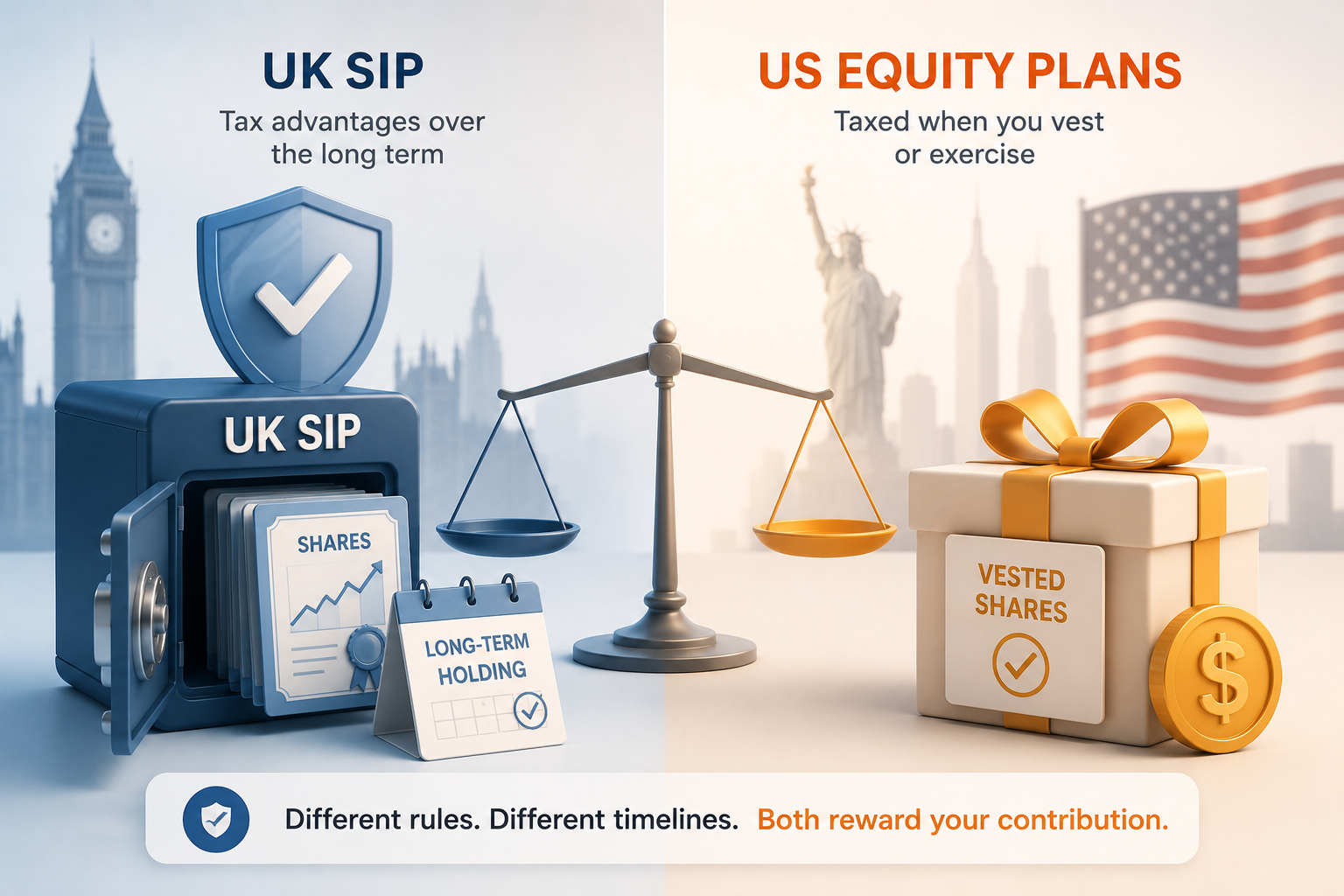
The single biggest difference between a SIP and its US counterparts isn’t the mechanics it’s the tax timeline. SIPs are built around a long holding period inside a trust; stay in long enough, and the growth in value can escape UK Capital Gains Tax entirely, on top of avoiding income tax and National Insurance on the original award (Saffery).
US equity compensation doesn’t work that way. RSUs are taxed as ordinary income the moment they vest, regardless of whether you sell the shares there’s no equivalent “wait it out and pay nothing” path. NSOs are taxed similarly at exercise. ISOs and qualifying ESPP dispositions can reduce the rate you pay on later gains if you hold long enough, but you’re still generally looking at capital gains tax on the appreciation, not a full exemption. And AMT exposure on ISOs is a US-specific wrinkle that has no SIP parallel at all.
Because these systems tax different events at different times, a UK SIP tax result and a US RSU or ESPP tax result are genuinely not comparable side by side without doing the calculation for your specific award type, vesting or purchase dates, and holding period. If you’d rather skip the manual math, you can estimate your equity compensation tax directly for your own numbers.
Common Mistakes US Readers Make About SIPs
Because the terminology overlaps but the underlying legal systems don’t, US-based employees researching SIPs tend to trip over the same handful of misunderstandings. Here’s what to watch for:
- Assuming SIP-style tax exemptions carry over to RSUs or ESPP shares. There’s no US equivalent of “hold it five years and owe nothing.” RSUs are taxed as ordinary income at vesting no matter how long you keep the shares afterward, so waiting it out the way you would with a UK SIP doesn’t reduce your US tax bill.
- Not accounting for AMT exposure when exercising ISOs. ISOs can offer favorable capital gains treatment if you meet the holding-period rules, but exercising a large batch in one year can trigger the Alternative Minimum Tax completely separate from anything a SIP holder would ever encounter. This catches people who plan around ordinary income tax rates alone.
- Confusing “free shares” (SIP) with RSU vesting mechanics. SIP free shares are awarded upfront and then held in trust, with the tax benefit tied to how long they stay there. RSUs are granted but don’t become yours (or taxable) until they vest over a schedule you don’t control. Treating an RSU grant date like a SIP award date will give you the wrong timeline for tax planning.
- Not checking whether an ESPP is “qualified” before assuming SIP-like treatment. A qualified Section 423 ESPP and a non-qualified ESPP are taxed very differently in the US, and neither maps cleanly onto SIP partnership share rules. Confirm your plan type before assuming a particular tax outcome.
- Using a UK SIP calculator on US equity. Because the tax triggers, rates, and holding-period effects are different, running RSU or ESPP numbers through a tool built for SIP rules will produce a result that looks precise but isn’t accurate for your situation.
Benefits of Employee Equity Plans, UK and US Alike
Regardless of which structure your employer uses, giving employees actual ownership tends to produce a few consistent effects worth understanding before you decide whether to participate: it gives you direct financial upside if the company performs well, it can come with real tax advantages compared to receiving the same value as cash bonus, and it tends to encourage a longer-term relationship with the employer since your reward is tied to sticking around through a vesting or holding period. For employers, equity awards attract and retain talent without the immediate cash outlay a bonus requires, and dilution rather than payroll is typically the tradeoff.
Risks to Understand Before You Participate
The upside gets most of the attention, but the risks are just as real. Your equity value is tied directly to a single company’s stock if the business underperforms or the stock price falls, both SIP shares and US RSUs/options lose value with no guaranteed floor. Vesting and holding-period rules mean you can lose some or all of the tax benefit (or the unvested shares themselves) if you leave your job at the wrong time. Concentrating a large share of your net worth in your employer’s stock also means your job security and your investment portfolio are correlated in a way that a diversified portfolio isn’t a downturn that hurts the company can hit your income and your equity value simultaneously. And on the US side specifically, ISOs carry an AMT risk that catches people who exercise a large number of options in a single tax year without planning around it.
Frequently Asked Questions
Is a Share Incentive Plan the same as an ESPP?
No, but they’re the closest functional match. Both let employees use their own pay to buy company shares, often with a discount or tax advantage attached. The legal structure, contribution limits, and tax rules are different because one is a UK scheme and the other is a US one.
Do US companies offer Share Incentive Plans?
Not under that name or legal structure. US companies offer economically similar benefits through RSUs, ESPPs, and stock options, which are governed by US tax law rather than the UK’s SIP legislation.
What’s the US equivalent of a UK SIP?
There isn’t a single one-to-one match. RSUs are closest to SIP free and matching shares, ESPPs are closest to SIP partnership shares, and ISOs/NSOs are closest to UK option schemes like CSOP or EMI.
How are RSUs taxed differently from SIP free shares?
RSUs are taxed as ordinary income at vesting no matter how long you hold them afterward. SIP free shares can become fully exempt from income tax, National Insurance, and Capital Gains Tax if they stay in the trust long enough there’s no equivalent “hold and avoid tax entirely” outcome with RSUs.
Can a Share Incentive Plan calculator help with RSUs or stock options?
A calculator built around UK SIP rules won’t give you an accurate answer for US equity, since the tax triggers and rates are different. You’ll want a calculation that’s specific to whether you’re estimating RSU vesting value, ESPP purchase discounts, or option exercise cost.
Summary
A Share Incentive Plan is a genuine UK scheme, not a generic industry term, and treating it that way is where a lot of confusion starts. If you’re a US-based employee who landed on this phrase, what you’re most likely trying to understand is your RSUs, your ESPP, or your stock options and while the underlying goal (giving employees a stake in company performance) is the same, the tax rules, timing, and risks are different enough that you shouldn’t assume UK SIP guidance applies to your US award. Get clear on which of the three US structures you actually have before you make any decision about participating, holding, or selling.
Ready to put real numbers to it? Try our free Share Incentive Plan Calculator to see what your RSUs, ESPP shares, or options could actually be worth.